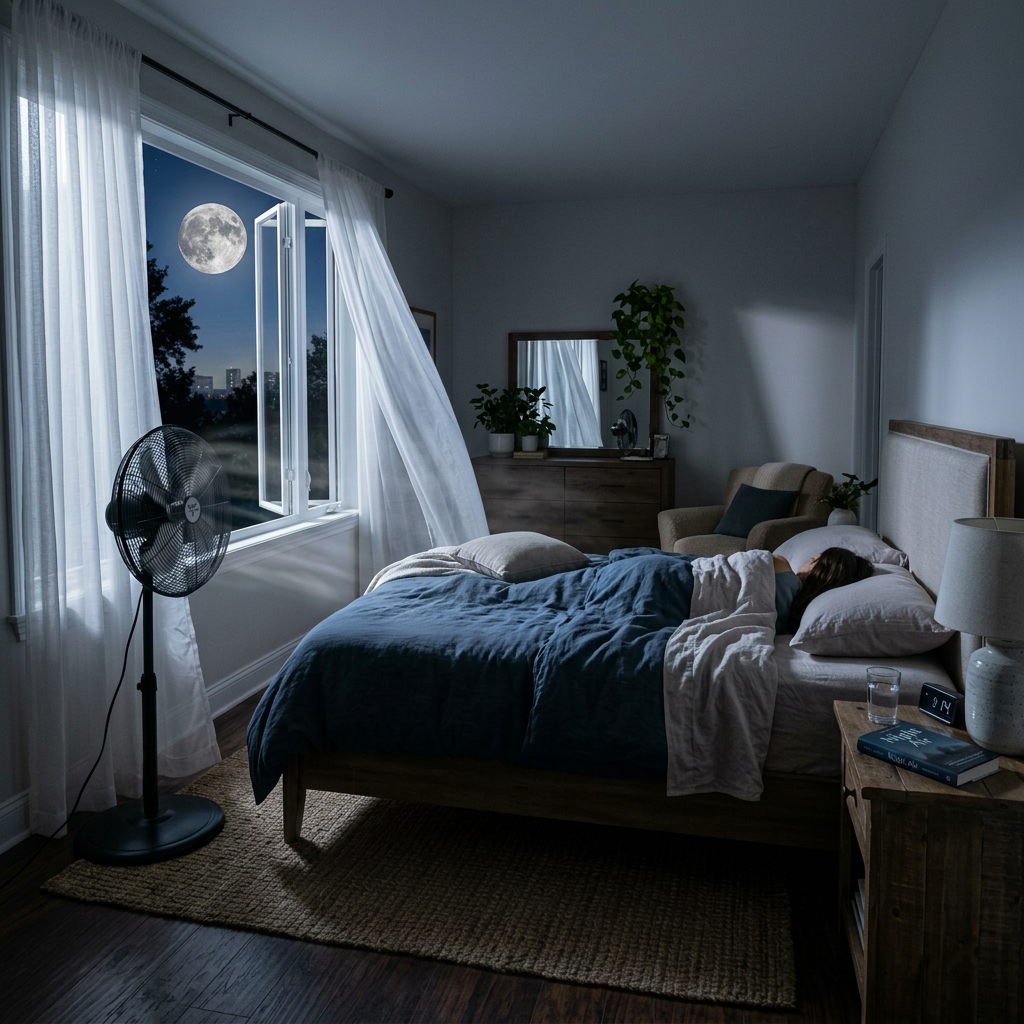
Every summer, I face the same battle in my apartment. The sun sets, the temperature stays stubbornly high, and I lie awake staring at the ceiling, wondering why I ever thought a top-floor flat was a good idea. Over the past few years I’ve tested everything fans pointed at walls, frozen water bottles, blackout curtains in colours I didn’t love and slowly built up a toolkit of tricks that genuinely work. Some of them I discovered through design research; others through pure sweating necessity. These are the seven that stayed.
How to cool a room without AC at night: Block heat during the day with blackout curtains, create a cross-ventilation corridor once temperatures drop after sunset, use a fan with a bowl of ice or a damp sheet for evaporative cooling, switch to breathable natural-fibre bedding, and lower your room’s thermal mass by removing heat-absorbing objects. These five steps alone can reduce perceived room temperature by 3–5°C without any mechanical cooling.
Why Rooms Stay Hot at Night (and Why Your Fan Isn’t Enough)
Before fixing the problem, it helps to understand it. During the day, your walls, floors, and furniture absorb heat, this is called thermal mass. At night, they slowly release it back into the room, which is why a bedroom can actually feel hotter at midnight than at 6pm. A standard fan circulates this stored heat rather than removing it. You’re not moving cool air; you’re moving warm air faster.
The fix isn’t to work harder with the wrong tool it’s to address the heat where it actually lives: in your walls, your windows, your bedding, and your body’s own cooling system.

1. Block the Heat Before It Enters (The Most Underrated Trick)
If there’s one thing I’d tell my past self, it’s this: the battle for a cool night is won during the day, not at midnight. Every hour of direct sunlight through your windows adds heat that your walls then store and release for the next six to eight hours. Blackout curtains particularly in white, cream, or light grey can block up to 99% of solar heat gain. I switched mine two summers ago and the difference was immediate.
You don’t need to live in a dark cave all day. Close curtains on the sun-facing side of your home from late morning until the sun moves past. East-facing rooms: close by 9am. West-facing rooms: close from around 2pm. North-facing rooms (in the northern hemisphere): largely safe to leave open.
If you’re renting and can’t change window treatments, a temporary alternative is reflective window film it peels off without damage and can be found in most hardware stores.

2. Create a Cross-Ventilation Corridor After Sunset
Once outdoor temperatures drop below indoor temperatures usually around 9–11pm in most European climates ventilation becomes your best friend. But random open windows don’t do much. What works is a deliberate cross-ventilation corridor: one low window open on the cooler side of your home (typically north or shaded), and one high window or door open on the opposite side. Hot air rises and exits through the high opening; cooler air is pulled in through the low one.
In my apartment, this means opening the bathroom skylight and the living room window simultaneously a combination that drops the bedroom temperature noticeably within 20 minutes, even on humid evenings.
For top-floor apartments where keeping house cool in extreme heat without AC feels impossible, this technique is especially valuable heat accumulates at the highest point of a building, so an upward exit route for hot air matters more than anywhere else.
3. The Fan + Damp Sheet Method (Better Than a Bowl of Ice)
You’ve probably seen the “fan + bowl of ice” trick online. It works, briefly, but the ice melts in 20 minutes and the humidity it adds can make a room feel clammier, not cooler. A more sustainable version: hang a damp (not dripping) cotton sheet in front of your fan. As the fan blows air through the wet fibres, evaporation pulls heat out of the air a basic version of how evaporative cooling works. The effect lasts as long as the sheet takes to dry, typically 45–90 minutes, which is usually long enough to fall asleep.
This works best in low-humidity conditions. In a humid climate or on a muggy night, skip this one the extra moisture will work against you.

4. Switch to Natural-Fibre Bedding
Synthetic bedding polyester duvets, microfibre sheets traps heat against your body because the fibres don’t breathe. Linen and cotton, particularly percale-weave cotton, do the opposite: they wick moisture and allow air circulation against your skin. Linen specifically has been shown in textile research to regulate temperature more effectively than most natural fibres, warming slightly in cool conditions and cooling slightly in warm ones.
If you can only change one thing in your bedroom for summer, make it the sheets. A percale cotton or linen flat sheet used alone no duvet can make a significant difference to how cool you feel through the night. I replaced mine three years ago and haven’t gone back.
For more on how your bedroom’s material choices affect sleep quality and comfort, this post on sensory bedroom design goes deeper into the connection between textiles and rest.
5. Lower Your Room’s Thermal Mass
This one sounds technical but is simple in practice. Thermal mass is the amount of heat your room’s objects can absorb and store. Dark dense objects, a black throw, a heavy wool rug, dark timber furniture store more heat than light, airy ones. On hot days, they soak up warmth and release it slowly overnight.
For summer, I move my heavy wool throw off the bed, roll up the dark rug and store it, and put away any dark decorative objects on the windowsill. I replace them with light-coloured, open-weave alternatives. It sounds small, but a room with lighter surfaces releases stored heat faster once you open the windows at night.
6. Cool Your Body, Not Just the Room
Your body has its own cooling system and working with it is often faster than fighting the room temperature. The most effective techniques:
- Cold water on pulse points (wrists, neck, ankles) before bed, your body cools the blood circulating through these points, which then cools your core temperature.
- A lukewarm shower (not cold) before sleep counterintuitively, a cold shower can cause your body to compensate by generating more heat. Lukewarm triggers the opposite response.
- Keep a damp flannel in a bowl of water by the bed for during the night.
Research from the Sleep Foundation confirms that core body temperature naturally drops during sleep onset, and that external cooling that assists this process significantly reduces the time it takes to fall asleep on hot nights. Source: Sleep Foundation — Best Temperature for Sleep.

7. Rethink Your Fan Placement
Most people point their fan directly at themselves. A more effective placement for cooling down an apartment without AC: point the fan out of the window rather than into the room. This creates negative pressure it actively pulls hot air out of the room rather than just recirculating it. Combine this with the cross-ventilation corridor from tip 2, and you have a simple mechanical extraction system that works surprisingly well.
If you have two fans, use one to pull air in from the cool side and one to push it out from the warm side. This is as close to mechanical climate control as you can get without installing anything permanent which matters enormously for renters.
For more renter-friendly home solutions that work without permanent changes, this guide to renter-friendly design hacks has practical ideas for every room.
One More Thing: The Order Matters
These seven tricks work best as a sequence, not a checklist you pick from randomly. Block heat during the day (tip 1), then ventilate once it’s cooler outside (tip 2), cool the air flowing through (tip 3), switch your bedding (tip 4), reduce stored heat (tip 5), cool your body before sleep (tip 6), and optimise your fan placement (tip 7). Done in order, on a hot evening, most people feel a difference within an hour.
The best part: none of these require permanent installation, significant spending, or anything you can’t undo before a landlord inspection.
FAQ: Cooling a Room Without AC at Night
What is the fastest way to cool down a room at night without AC?
The fastest combination is cross-ventilation (open windows on opposite sides of your home after outdoor temperatures drop) plus a damp sheet in front of a fan. Together, these can noticeably reduce perceived room temperature within 20–30 minutes.
Does putting ice in front of a fan actually work?
Briefly, yes but the effect fades as the ice melts (typically within 15–20 minutes) and the added humidity can feel uncomfortable. A damp sheet hung in front of the fan is more sustainable and works for longer.
How do I keep a top floor apartment cool in summer without AC?
Top floors accumulate heat because hot air rises through the building. The key is creating an upward exit for that heat: open a high window or roof skylight at night to let heat escape, while pulling cooler air in through a lower window on the shaded side of your home. Blackout curtains during the day are non-negotiable for top-floor apartments.
What bedding is coolest for hot nights?
Linen or percale-weave cotton used as a flat sheet without a duvet is the most effective option. Both fabrics wick moisture and allow air circulation against your skin. Avoid polyester and microfibre, which trap heat.
Enjoyed these tips? Save this post and follow @Lindadesign20 on Pinterest for weekly home design ideas, sensory interior inspiration, and practical solutions for beautiful, comfortable living.
Latest Post
- Muslim Prayer Corner Ideas for Small Spaces (No, You Don’t Need a Spare Room)
- Pantry Organization Ideas for Big Families (Renter-Friendly)
- Bold Renter-Friendly Kitchen Ideas That Aren’t Beige
- Zellige Without Retiling: Renter-Friendly Moroccan Tile Ideas
- How to Cool a Room Without AC at Night: 7 Designer Tricks That Actually Work
Linda is a home décor enthusiast and the designer behind Linda Design Shop Co. She writes about beautiful interiors and creates bilingual wedding stationery for meaningful celebrations.