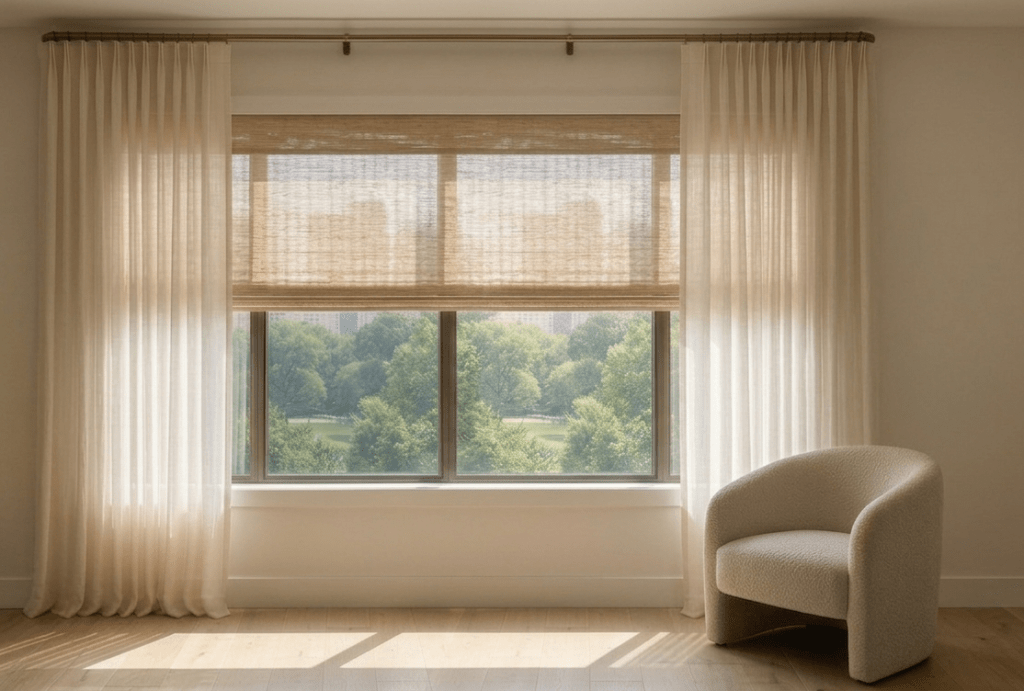
- What Is Window Layering for Heat Control?
- Choosing a Stylish Film (Not the Mirrored Office Look)
- Stylish Heat Reflective Window Film vs Curtains: What the Film Does That Curtains Cannot
- Why Solar Shades Beat Standard Roller Blinds for This Technique
- Woven Bamboo and Rattan: The Aesthetic Upgrade
- Why Linen Works Better Than Velvet for Summer Heat Management
- Hanging Technique: The Floor-to-Ceiling Illusion
- Pairing Curtains with Acoustic and Sensory Goals
- Budget Breakdown: What This Actually Costs
Quick answer: The stylish heat reflective window film vs curtains debate has a clear winner for most rooms but the real magic happens when you use both strategically. This guide breaks down the exact three-layer method that keeps rooms cool, luminous, and genuinely beautiful all summer long.
Here’s a question I get every June: why is my living room suffocating even though the blinds are shut? Blinds help a little. But standard horizontal slats trap hot air in the window cavity rather than deflecting it at the glass. And heavy blackout curtains kill every last beam of natural light you spent months positioning furniture around.
Summer heat through windows is not a curtain problem. It’s a radiation problem. The solution, after years of redesigning my sun-drenched apartments, is layering three distinct layers, each doing a different job. Think of it like UV-protection skincare: each product works where the others can’t reach.
What Is Window Layering for Heat Control?
Window layering for heat control is a design method that combines three functional elements heat-reflective film applied directly to glass, a solar shade or woven blind for glare diffusion, and light linen or sheer curtains for airflow insulation to reduce solar heat gain by up to 75% while preserving natural light and maintaining interior aesthetics.
Hack #1: Start at the Glass — Heat Reflective Window Film (The Invisible Layer)

Most people treat the glass as a given. A fixed, transparent wall they can only dress around. That is the mistake.
Window film specifically low-e or solar control film intercepts infrared radiation before it even enters the room. Good-quality films reject between 55% and 79% of total solar energy. That number is not cosmetic. It translates directly to surface temperatures: a west-facing window in July can drop from a surface temp of 42°C (108°F) to under 28°C (82°F) with a quality solar film applied. The room feels cooler before you’ve touched a single curtain.
Choosing a Stylish Film (Not the Mirrored Office Look)
The phrase “window film” still conjures that blueish mirrored office aesthetic. Justified early films were terrible. But ceramic-based films in neutral warm tints have become genuinely attractive. A light bronze or barely-there grey tint adds visual depth without altering the room’s colour cast. Architects specify them in high-end residential projects for exactly this reason.
For renters: most quality films use static cling or light-pressure adhesive rather than permanent glue. Applied correctly, they leave zero residue on removal.
Designer tip: Avoid silver-mirrored films in living spaces. Choose neutral bronze, warm grey, or ceramic-clear films with a visible light transmittance (VLT) of 50–70% to maintain natural light quality and avoid a surveillance-camera ambience.
Stylish Heat Reflective Window Film vs Curtains: What the Film Does That Curtains Cannot
Curtains, however beautiful, work by absorbing solar energy which they then re-radiate back into the room as heat. A dark linen curtain soaks up sunlight and warms the air between itself and the glass. That warm air pocket then convects into the room. This is physics, not a design flaw.
Film, applied directly to the glass, reflects radiation outward before it converts to heat at all. It’s a fundamentally different mechanism. In the stylish heat reflective window film vs curtains comparison, curtains win on aesthetics, texture, and acoustic softening but film wins on thermal performance at the source. Which is precisely why you need both.
| Feature | Heat Reflective Film | Curtains / Drapes |
|---|---|---|
| Heat rejection mechanism | Reflects solar radiation at glass | Absorbs and partially re-radiates |
| Light preservation | High (50–70% VLT films) | Varies; blackout = near zero |
| Aesthetic impact | Minimal / invisible | Strong visual statement |
| Renter-friendly | Yes (removable films) | Yes (tension rods) |
| Acoustic benefit | None | Moderate |
| Cost range | €15–€80 per window | €30–€300+ per panel |
The table above should settle the debate. Neither product is superior, they operate in different thermal zones. The film deals with radiation; curtains deal with convection and air insulation. Stack them, and you address both.
On the topic of light quality: natural light has a measurable effect on daily rhythm and mood. If you’ve read my piece on retrofitting circadian lighting without a smart hub, you’ll know I’m a firm believer in protecting morning light access in particular. A film that preserves 65% visible light transmittance does this beautifully the room still fills with that golden, diffuse morning glow, minus the sauna effect.
Hack #2: The Middle Layer — Solar Shades and Woven Blinds (The Glare Diffuser)
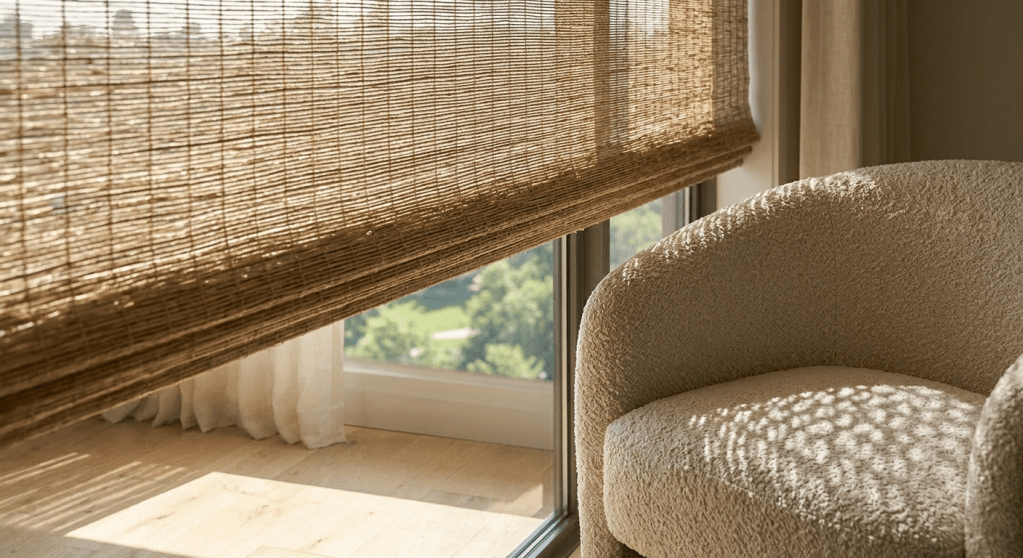
With film on the glass, you’ve already cut your heat load substantially. But direct afternoon sun still creates glare. And glare that harsh, flat brightness that washes out colours and makes screens unreadable is a separate problem from heat. It needs its own solution in the layering stack.
Enter the solar shade.
Why Solar Shades Beat Standard Roller Blinds for This Technique
Standard roller blinds, when lowered, create an opaque barrier. You lose the view. You lose visual connection to the outside. In biophilic design terms, this is a significant loss exterior views and contact with natural movement (trees, clouds, passing light) have measurable calming effects on the nervous system. I explored this connection in depth in my article on why fractal patterns in decor calm the human brain the principle applies equally to window views.
Solar shades are made from an open-weave mesh fabric typically a 3% to 10% openness factor that filters brightness without blocking the view. With a 3% openness solar shade, you can see through clearly from the inside while exterior-facing glare is cut by 70–80%. From outside, the fabric appears solid, which is an added privacy bonus during daylight hours.
Woven Bamboo and Rattan: The Aesthetic Upgrade
Solar shades are functional first. But woven bamboo or rattan Roman shades occupy a more interesting design space: they filter light into warm, dappled patterns that scatter across walls and floors in ways that feel organic and almost theatrical. The weave creates what amounts to a natural pattern projection similar in spirit to the fractal visual experiences that research associates with reduced cortisol response.
For a south or west-facing window, I often recommend a tight-weave bamboo shade (light filtering, not blackout lining) positioned in front of the window film. The combination creates extraordinarily beautiful afternoon light soft, honeyed, dappled while keeping solar gain in check.
Openness factor guide: 1–3% for direct west/south sun exposure (maximum glare reduction). 5–10% for east-facing windows or rooms where you want more visual openness. Pair with film for heat; the shade handles glare only.
“Good window design doesn’t choose between light and comfort. It engineers both simultaneously.”
One practical note for renters: solar shades fit inside window frames on tension-mount brackets in most standard window sizes. No drilling, no damage, no landlord conversation needed. The same applies to bamboo Roman shades with command-strip mounting hardware not all shades support it, but more do now than ever.
Hack #3: The Outer Layer — Linen and Sheer Curtains as Insulating Frames
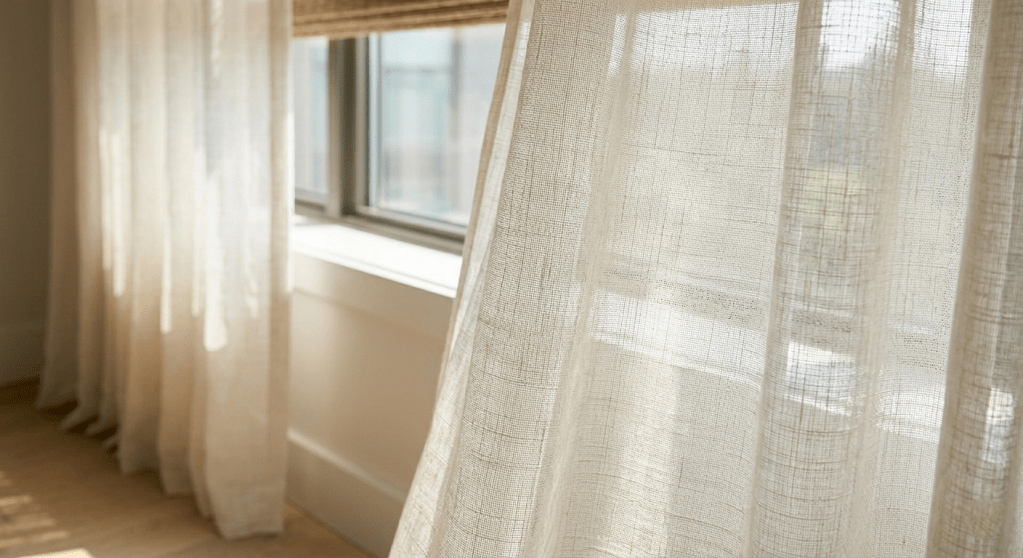
This is where the aesthetic really lives. And honestly, this is the layer that most people do first which is why they end up disappointed when the room is still hot by 3pm despite having beautiful curtains.
Curtains hung as the outermost layer, after film and solar shading are already in place, serve two functions that are purely additive: they create an air gap that insulates against convective heat transfer, and they frame the window in a way that makes the entire composition look intentional and finished.
Why Linen Works Better Than Velvet for Summer Heat Management
Linen is a genuinely remarkable textile for warm climates and not just for cultural reasons, though Mediterranean and North African design traditions have known this for centuries. Linen’s natural structure allows for airflow rather than trapping heat against the fabric surface. A loosely woven natural linen panel in off-white or undyed ecru allows soft light diffusion when the solar shade above is partially raised, creating an effect that feels luminous and airy rather than dim and enclosed.
Velvet and heavy chenille, by contrast, absorb heat beautifully which is exactly what makes them ideal for winter insulation and entirely counterproductive in summer. Thermal mass works both ways.
Hanging Technique: The Floor-to-Ceiling Illusion
Hang the curtain rod as close to the ceiling as possible within 5–10 cm. Let panels pool 2–4 cm on the floor. This reads taller and more proportionate, while the sealed air column between curtain and wall acts as a buffer zone slowing convective heat transfer a principle borrowed from passive solar architecture.
Wide panels matter more than most people realise. Each panel should extend at least 30 cm beyond the window frame on each side when open, allowing full light access while covering the window completely when drawn with no heat-leaking gaps at the edges.
Pairing Curtains with Acoustic and Sensory Goals
Since I started applying this layering method to full room redesigns, I’ve noticed an interesting secondary benefit: the multi-layer window treatment significantly reduces outside noise intrusion. The combination of glass film (small acoustic dampening), a fabric shade, and a linen curtain panel creates meaningful sound attenuation not soundproofing, but enough to soften the edge of street noise and create a quieter interior atmosphere.
This connects directly to something I care about in every room I style: the overall sensory quality of a space. If you’ve been following my writing on the threshold effect in sensory entryway design, you’ll recognise the principle transitional sensory comfort at the perimeter of a space reduces anxiety responses and makes the interior feel genuinely safe and restorative.
Windows are thresholds too. Between outside chaos and interior calm. Between solar assault and cool, luminous refuge. Treating them as such with intention and layering logic changes how every room feels to inhabit.
The Complete Three-Layer Stack: What It Looks Like in Practice
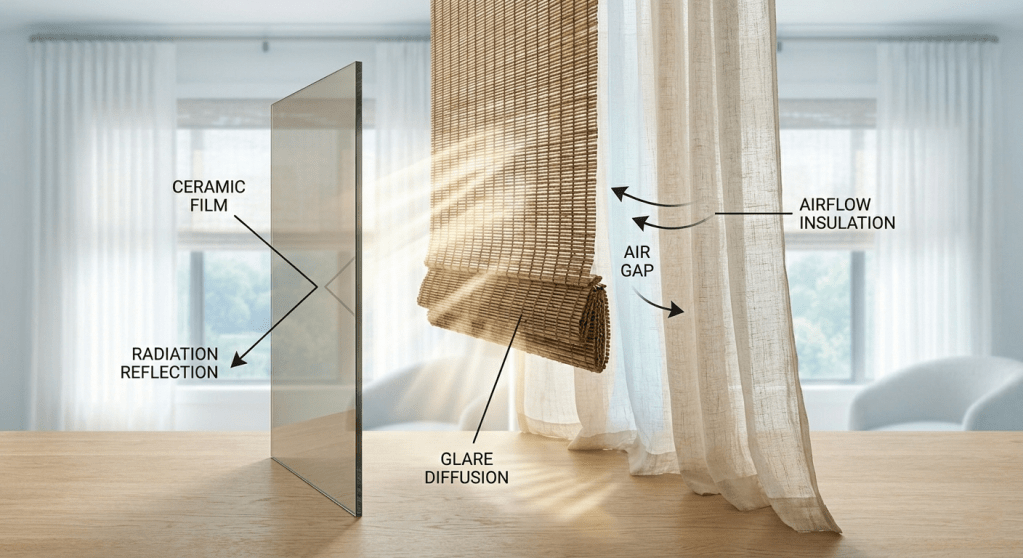
Let me make this concrete. Here’s how I’d apply the method to a typical west-facing living room window in an apartment that gets brutal late-afternoon sun:
Layer 1 (Glass): A neutral warm-tint ceramic solar film, 60% VLT, applied to the inside of the glass. Installation takes about 40 minutes per window with a squeegee and soapy water. Removable. Rejects approximately 65% of solar heat at source.
Layer 2 (Window): A woven bamboo Roman shade, medium-weave, mounted inside the window recess on a tension bracket. Pulls up completely during morning hours for full light. Lowered from 1pm onwards during peak sun. Creates warm dappled light when lowered the room looks more beautiful, not less, with it down.
Layer 3 (Frame): Two floor-to-ceiling linen panels in undyed ecru, hung from a tension rod mounted 8 cm from the ceiling. Panels sit 35 cm beyond the window frame on each side when open. Drawn partially closed during peak afternoon heat for added insulation.
The combined result in a real room: surface temperatures at the window drop noticeably to the touch, the room maintains usable ambient light through the afternoon, and critically the window composition itself becomes the most commented-on element in the room. Heat management should not be aesthetically neutral. These three layers make it genuinely beautiful.
Budget Breakdown: What This Actually Costs
A common concern is whether this three-layer system is expensive. It doesn’t have to be. Here’s a realistic range for a standard 120 × 140 cm window:
| Layer | Budget Option | Mid-Range Option |
|---|---|---|
| Ceramic solar film | €12–€18 (DIY kit) | €35–€60 (professional grade) |
| Woven / solar shade | €25–€45 (IKEA, Maisons du Monde) | €80–€140 (artisan woven) |
| Linen curtains (2 panels) | €30–€55 (H&M Home, La Redoute) | €100–€200 (Zara Home, Lin Français) |
| Total per window | €67–€118 | €215–€400 |
Compare that figure to running a portable AC unit for a French summer typically €0.15–€0.22 per kWh at 900W continuous. The window system pays for itself in a single season.
The Biophilic Case for Keeping Light, Not Blocking It
Natural light is not optional. It is not a luxury feature you sacrifice for thermal comfort and most heat-management guides skip this entirely.
Studies in biophilic environmental design show consistently that access to natural light, particularly morning light with warm colour temperature, regulates cortisol production and improves mood stability. Blocking light to block heat trades one discomfort for a subtler one: the low-grade hormonal disruption of living under artificial light during daylight hours. The five biophilic design elements that genuinely reduce stress I’ve explored include exterior visual connection which this layering method deliberately preserves. The shade and curtains filter; they do not block. That distinction is everything.
For east or south-east facing windows, keep Layers 2 and 3 fully retracted until 11am. Let morning light filtered only by the transparent film fill the room. This connects to why I’ve written about decor tricks for stress-reducing morning routines morning light architecture is interior design too.
A Note on Renter-Specific Installation: Zero Damage Methods
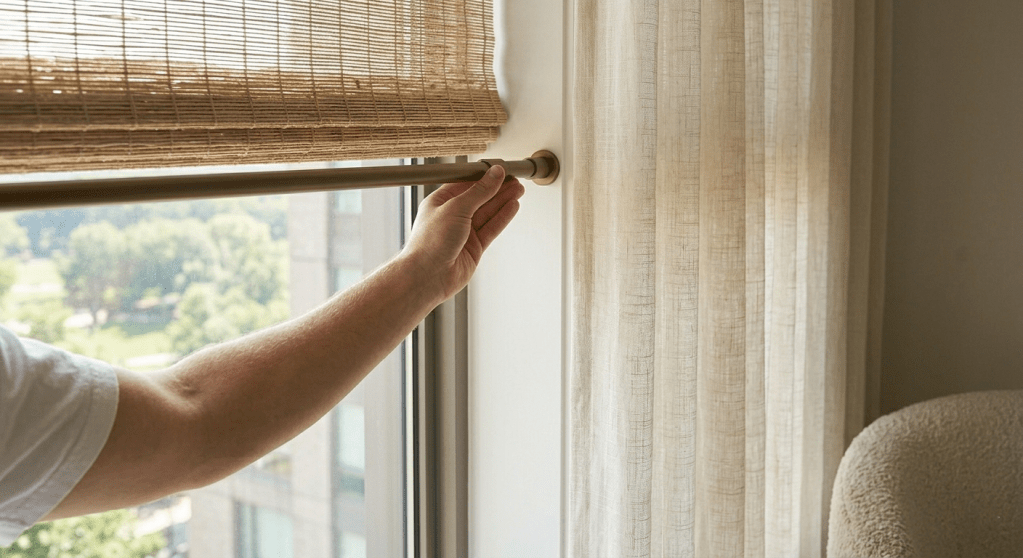
Everything here works without drilling. Window film uses static cling or light-pressure adhesive soapy water application, squeegee removal, zero residue. Solar shades in standard sizes mount on spring tension brackets. Bamboo Roman shades fit adhesive-mounted brackets rated to 4 kg. Curtain rods: tension rods for window-width panels; adhesive curtain rail systems (Umbra, KVARTAL-style) now hold reliably up to 8–10 kg for full wall-width installations.
All three layers are reversible in under an hour. None require a landlord conversation. The windows leave exactly as you found them, the room will not.
The Window Is Not a Problem to Solve: It’s a System to Design
The stylish heat reflective window film vs curtains debate is the wrong question. Both work. Neither works alone. Film handles radiation at the source; solar shades manage glare and mid-day intensity; linen curtains insulate against convective transfer and anchor the room aesthetically.
Three layers. Three different jobs. One cohesive, beautiful, thermally efficient window composition.
Summer heat is a design problem. Which means it has a design solution one that looks exactly as intentional as it is. If you’re rethinking your living room for the season and want to go deeper into sensory comfort, I’d recommend reading my guide on sensory design for anxiety relief the same principles that make a window treatment calming apply to every transitional space in your home.
Linda Designs
 Linda Designs | Home Decor, Interior Design & Lifestyle Inspiration