There’s a moment most of us have experienced standing at the edge of a forest, watching waves break on a shore, or staring up into a canopy of branches when something in the body just… lets go. The shoulders drop. The breath slows. The noise in your head gets quieter. For the longest time, we called it “being in nature.” Science, it turns out, has a far more precise explanation. And it has everything to do with your walls.
Welcome to the world of biophilic fractal patterns in interior design one of the most quietly revolutionary ideas reshaping how we think about calm, beauty, and the spaces we inhabit every day.
What Are Fractal Patterns, Exactly?
Fractals are geometric patterns that repeat at every scale. Zoom in on a fern leaf, and you see smaller ferns. Zoom into a coastline, and you find the same jagged rhythms, infinitely nested. Nature is overwhelmingly fractal from snowflakes and river deltas to the branching of your own lungs.
They are not random. They are not perfectly ordered either. They exist in between and that in-between is precisely what makes them so powerful.
Mathematician Benoit Mandelbrot coined the term “fractal” in 1975, but humans have been drawn to these patterns for millennia. Moroccan zellige tiles. Gothic cathedral windows. Japanese wave paintings. We have always put fractals on our walls. We just didn’t know why.
Now we do.

The Science Behind the 60% Stress Rule
What is the 60% stress rule in interior design? The 60% stress rule refers to the finding that viewing fractal patterns with a dimension (D) between 1.3 and 1.5 the complexity range found in natural environments can reduce physiological stress levels by up to 60% by inducing alpha wave activity in the brain.
How Your Brain Reads Visual Patterns
Neuroscientist Richard Taylor at the University of Oregon conducted a series of landmark studies on how the human eye and brain respond to different levels of visual complexity. His team measured something called fractal dimension (D) a number between 1 and 2 that describes how complex or “fractal-dense” a pattern is.
What they found was striking. Patterns with a fractal dimension of approximately D = 1.3 to 1.5 which is exactly what you find in natural environments like forests and clouds produced a measurable stress reduction of up to 60% in test subjects. That number has since been replicated in multiple studies, and it has become a kind of benchmark in environmental psychology.
Sixty percent. Not marginal. Not subtle. That’s the kind of reduction that makes a real, felt difference in how a room or a day actually feels.

The Alpha Wave Connection
When subjects viewed fractal patterns at that sweet-spot complexity level, their brains showed increased alpha wave activity. Alpha waves are associated with relaxed alertness the mental state you’re in during meditation, creative flow, or the quiet minutes just after waking. This isn’t a placebo. It’s a measurable neurological response, happening in milliseconds, before conscious thought even enters the picture.
Your nervous system, in other words, is doing a kind of pattern-matching. It recognizes fractal geometry as safe. As home. As the visual signature of a world where predators aren’t lurking behind clean drywall.
We evolved in nature. Our brains still expect it.
Why This Matters for Your Interior Design
Most modern interiors are fractal deserts. Flat paint. Smooth surfaces. Rectilinear furniture. Clean lines, yes but neurologically speaking, also boring and slightly stressful in a way that’s hard to name. You walk into a room that looks “nice” and still feel vaguely tense. Sound familiar?
This is where biophilic fractal patterns in interior design stop being an abstract theory and start being a practical toolkit.
If you’ve been exploring biophilic design elements that reduce stress, you’ll already know that nature-referencing design isn’t just aesthetic preference it’s physiology. The fractal dimension principle takes that even further by giving us an actual measurable target.
The goal isn’t to fill your home with plants (though, yes, please do that too). It’s to ensure your environment contains enough visual complexity at the right frequency to keep your nervous system in that alpha-wave, parasympathetic sweet spot.

How to Introduce Fractal Patterns Into Your Home
Wallpaper and Wall Art — The Fastest Impact
The wall is your largest canvas. It has the most opportunity to hit that D = 1.3–1.5 sweet spot. Look for:
- Botanical wallpapers with overlapping leaf or branch structures
- Geometric prints based on Penrose tilings or Moorish lattice work
- Watercolor or ink wash art with organic edge detail
- Wood grain feature walls, which are naturally fractal at multiple scales
Even a single large-format print of a forest canopy or a crashing wave can shift the sensory character of an entire room. Don’t underestimate scale.
Aesthetic Acoustic Wall Panels for Renters — Function Meets Fractal
Here’s a detail that doesn’t get nearly enough attention: aesthetic acoustic wall panels for renters can serve double duty as fractal-rich wall features and many of the best ones are designed with exactly this in mind.
Acoustic panels with wavy, irregular, or tessellating surface patterns don’t just absorb sound (reducing auditory stress); they also introduce fractal-like visual complexity to an otherwise flat wall. For renters who can’t paint or wallpaper, this is genuinely one of the most impactful changes you can make. They go up without damage, come down without drama, and work on a visual-neurological level that’s backed by real science.
Look for panels with organic curves, leaf-inspired cutouts, or wood veneer surfaces. Avoid perfectly uniform grid patterns those are too ordered to hit the fractal sweet spot.

Textiles and Layering
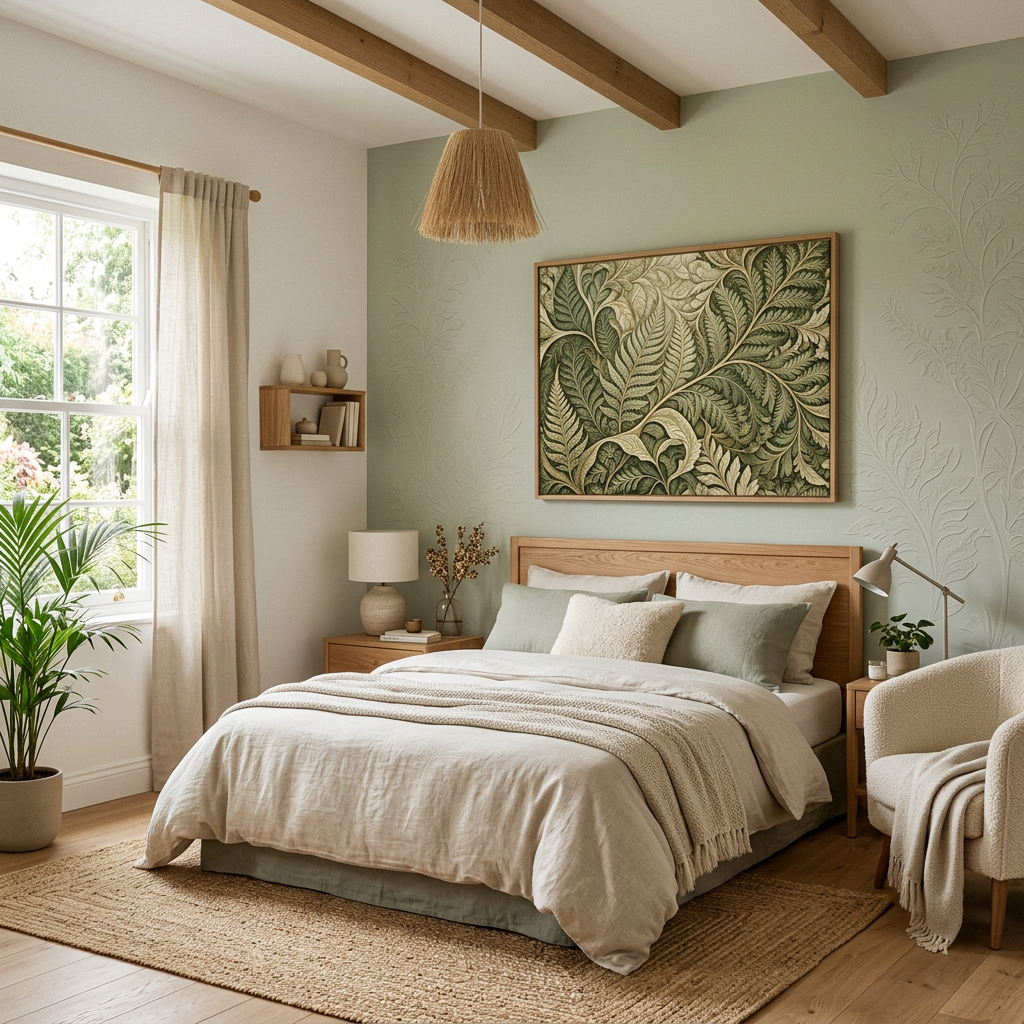
Rugs, throws, cushions, curtains these are fractal delivery systems. A Persian or Moroccan-style rug with nested geometric patterns is doing exactly what the neuroscience prescribes. So is a linen curtain that catches light in slightly different ways across its weave. Layering textures rough linen over smooth velvet, knotted wool over polished wood creates the kind of micro-variation that your nervous system quietly loves.
This connects directly to creating an intentional sensory environment. If you want to go deeper on the multi-sensory side of calming your home, my guide on scent, sound, and sensory sanctuary design pairs beautifully with everything we’re covering here.

Plants — The Original Fractal Delivery System
Yes. Always yes. Ferns, in particular, are extraordinarily fractal. So are monstera, pothos cascading down a shelf, and any trailing vine allowed to find its own shape. A cluster of plants in a corner doesn’t just add “greenery” it introduces genuine biological fractal complexity that your visual cortex recognizes and responds to in real time.
Place them where you actually sit and look. Not in corners you walk past. In your sightline.
Room-by-Room Application
Bedroom — Low Complexity, Deep Calm
For sleep, you want fractal patterns on the quieter end of that range — closer to D = 1.3. Think soft botanical prints, wood-grain textures, linen bedding with visible weave. Avoid high-contrast geometric patterns, which can tip toward stimulating rather than calming.
If you’ve been thinking about your bedroom as a stress-relief space (and you should be), this principle connects directly to the ideas in my post on daily mindfulness habits to start in the bedroom. The visual environment and the behavioral practice reinforce each other.
Living Room — Richer Complexity, Social Energy
The living room can handle the fuller range — D = 1.4 to 1.5. This is where a feature wall with botanical wallpaper, a layered gallery wall with organic shapes, or a large nature photograph really earns its place. Add a textured rug, throw pillows in varied natural fabrics, and a plant or two, and you’re building a genuinely neurologically supportive space.
Home Office or Meditation Corner — Intentional and Focused
For focus, you want just enough fractal complexity to prevent that flat-wall agitation, but not so much that it becomes distracting. A single piece of nature-inspired wall art. A plant at the periphery. Natural wood on the desk surface. These create the conditions for the relaxed alertness the alpha wave state that’s associated with both deep focus and meditation practice.
If you’re designing or refining a meditation space, the beginner’s guide to meditation corners at home goes deep on the design principles that make these spaces actually work.

The Morning Dimension — Starting Your Day in a Fractal Environment
There’s something worth saying about mornings specifically. The first visual inputs of your day set a kind of neurological tone. A bedroom that wakes you into fractal complexity soft natural light hitting a textured wall, a plant catching the morning sun, a piece of art with organic movement is doing something fundamentally different from one that opens onto blank white ceilings and smooth beige paint.
Small changes here compound over time. If you’re working on building calmer, more intentional mornings, the decor tricks for stress-reducing morning routines post is the practical companion piece to everything the science is telling us here.
A Note on Getting It Wrong
More is not always more. A fractal dimension above D = 1.8 starts to feel chaotic think cluttered maximalism where nothing has room to breathe. The research is specific: the stress-reduction sweet spot is mid-range complexity. That means curation matters. You’re not layering pattern upon pattern upon pattern. You’re introducing enough organic visual rhythm that the room feels alive rather than sterile.
The difference between a calm biophilic interior and an overwhelming one is almost always restraint in the right places. Keep surfaces and furniture relatively clean. Let the fractal elements the plants, the textured wall, the layered rug have room to do their work.
Final Thoughts — Design That Works While You’re Not Thinking About It
This is what I find most remarkable about the science of biophilic fractal patterns in interior design: it doesn’t require your participation. You don’t have to actively notice the fractal geometry of a fern or consciously appreciate a botanical print. Your nervous system is doing the work, automatically, in the background, the entire time you’re in the room.
That’s the real promise of this approach. Not rooms that look calming. Rooms that are calming measurably, neurologically, on a level that bypasses opinion and goes straight to physiology.
Sixty percent. That’s not a small number. That’s the gap between a space that quietly exhausts you and one that quietly restores you.
Worth a fern and a textured panel, don’t you think?
Linda is a home décor enthusiast and the designer behind Linda Design Shop Co. She writes about beautiful interiors and creates bilingual wedding stationery for meaningful celebrations.
One response to “The 60% Stress Rule: Why Fractal Patterns in Decor Calm the Human Brain”
[…] explored the measurable impact of these patterns in detail when writing about the 60% stress rule and fractal patterns in decor that research maps directly onto why organic brutalist surfaces work on us the way they do. […]