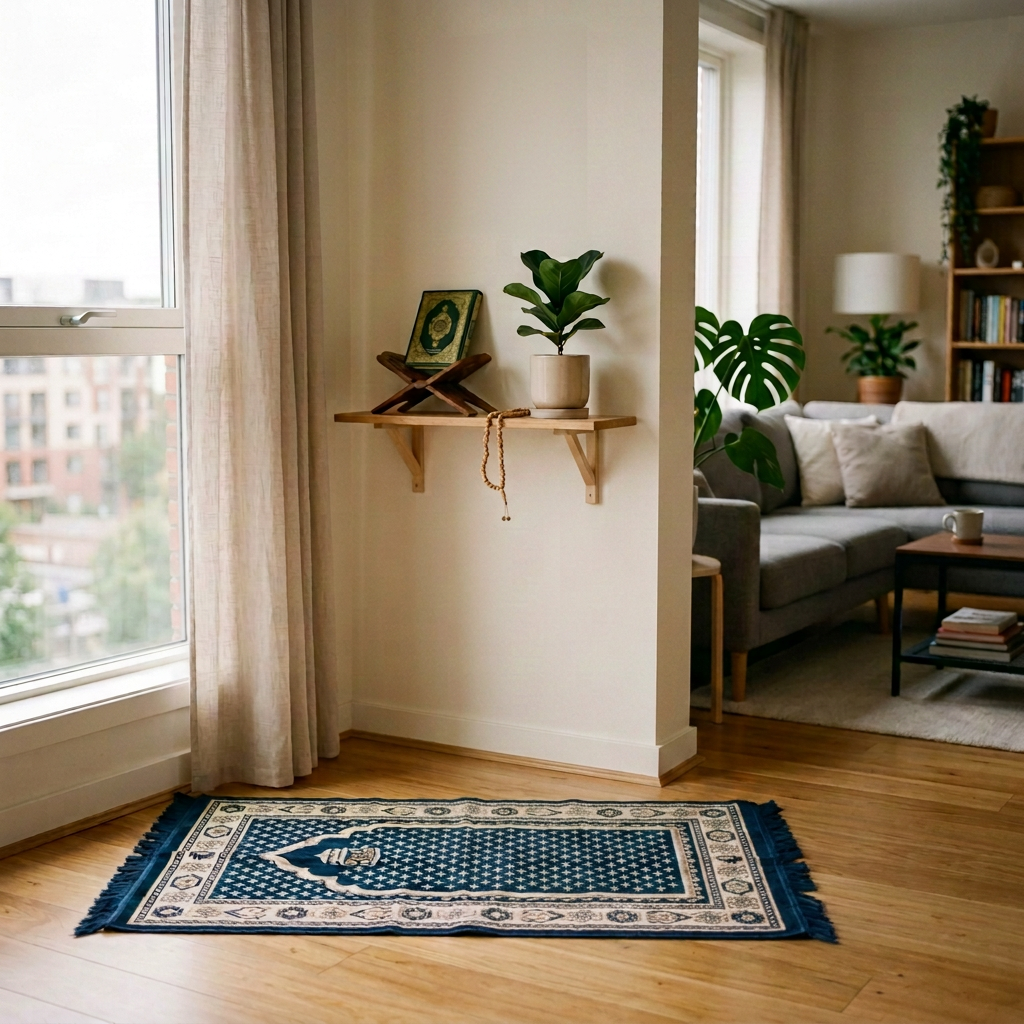
A muslim prayer corner for a small space doesn’t need a dedicated room a clean 3×3 foot area with a prayer mat, a qibla marker, and minimal visual clutter is enough. The goal is consistency and calm, not square footage.
My first real prayer corner was in a 60m² furnished rental in Rotterdam one big open space with a single door, the entrance. No walls to work with, no natural divide, nothing that said “this part is separate.” What I needed was somewhere calm, somewhere my mat could stay put without anyone walking across it mid-prayer.
I tried a few different setups, working out from the qibla direction each time. What finally worked was the end of my bed far enough from the flow of foot traffic that nothing disturbed me, close enough that I could sit there after and just be still for a minute before getting back to the day. It wasn’t the spot I expected to land on. It was the one that actually worked.
Here’s the thing about prayer corners nobody says out loud: most of the advice out there wasn’t written for you. Type “prayer corner ideas” into Pinterest and you’ll get an avalanche of crosses, rosaries, and “prayer closet” makeovers beautiful, sure, but not what you’re looking for if you’re trying to figure out where your prayer mat goes in a 550-square-foot rental.
That gap is real. I went looking for it myself before writing this.
What a Muslim Prayer Corner Actually Needs (Less Than You Think)
Strip it down to essentials and a prayer corner needs exactly three things: enough clear floor space for a mat, a sense of which way is qibla, and enough visual quiet that your brain switches modes when you step into it. There’s real research behind that last point Princeton’s own research on visual clutter found that the more competing objects are in your visual field, the harder it is for your brain to settle into a single task, which tracks with why a cluttered corner never quite feels like a place to pray, even when the mat’s right there. That’s it. No shelf of religious texts required, no dedicated lighting rig, no wall you have to paint.
Which means the “small spaces” problem is smaller than it feels. You’re not trying to carve out a room. You’re trying to carve out a corner and corners are the one thing every apartment has too many of and no plan for.

How Much Space You Actually Need (In Real Numbers)
It helps to get concrete about this, because “small corner” means different things to different people.
| Space Setup | Minimum Dimensions | Recommended Floor Area |
|---|---|---|
| Single mat only | 2 x 3.5 ft | Foot of bed or tight closet nook |
| Single adult (standing/prostrating) | 2.5 x 4 ft | Under-window or bedroom corner |
| Two people (side by side) | 5 x 4 ft | Living room corner with pull-out rug |
None of these numbers require moving furniture permanently. A 5 x 4 foot rug that lives under a coffee table most of the day and gets pulled out for prayer is a completely normal way to handle this in a small apartment the space doesn’t have to be dedicated 24/7 to still function as a real prayer corner.
Muslim Prayer Corner Ideas for Bedrooms
The bedroom corner is the most common setup, and for good reason it’s already private, already quiet, and you’re probably praying there at the start and end of the day anyway.
A few concrete versions that work in a rental:
- The under-window corner. If there’s a window, use it. Natural light does more for the feel of a space than anything you can buy, and you’re not drilling anything to get it.
- The foot-of-the-bed roll-out. This is the one that worked for me in a fully open-plan Rotterdam rental no walls to divide the space, just distance from the door and the everyday foot traffic. The mat lives rolled in a basket or tucked away, and the “corner” is wherever there’s floor when you unroll it. It also happens to be a good spot to sit for a minute after you’re done, before stepping back into the rest of the day.
- The closet-adjacent nook. If your closet has any dead space next to it (a lot of rentals have this awkward gap), that’s often just wide enough for a folded chair or small shelf plus mat storage.

Muslim Prayer Corner Ideas for Living Rooms and Shared Spaces
Harder, because it’s not private by default but not impossible.
A low room divider (the folding, no-drill kind) can turn one end of a living room into a visually separate zone without losing the square footage when you don’t need it. A floor cushion doubles as prayer-mat storage and regular seating, so it doesn’t read as “the prayer corner” the rest of the day. And if you’re working with genuinely open-plan everything, even just angling a single piece of furniture a bookshelf, a plant stand to create a soft visual break does more than you’d expect.

Muslim Prayer Corner Under Stairs or in Awkward Nooks
This one surprised me when I found it in the research “under stairs” showed up specifically as a search phrase, which tells you people are actually solving for this. Under-stair space is oddly perfect for a prayer corner: it’s already separated from the main room by geometry, it’s usually not being used for anything else, and even a low-ceiling triangle of space is fine, since you’re kneeling and sitting more than standing.
If you’ve got one of these awkward leftover spaces in your place, it might be your best option before you even look at the “real” rooms.

Keeping It From Looking Cluttered (Small-Space Decor Basics)
Here’s where I’ll be honest: the fastest way to ruin a small prayer corner is decorating it like it needs to prove something. One piece of wall art. One small shelf, if you use it. A mat that rolls or folds flat when not in use, so the space reverts to “just a corner” the rest of the day.
If you want a bit of texture or color without adding clutter, a single zellige-inspired accent a small tile panel behind a shelf, or even a removable option can do that work without committing wall space to a “theme.” I went deep on renter-friendly ways to bring zellige into a space without retiling in Zellige Without Retiling: Renter-Friendly Moroccan Tile Ideas, if you want ideas that go beyond the prayer corner itself.

What Not to Overthink
You don’t need matching decor. You don’t need a “theme.” You don’t need it to look like the aspirational riad photos that dominate the aesthetic side of this search those are beautiful, and also mostly shot in actual Moroccan buildings with actual arched ceilings, not 2026 rental units with popcorn ceilings and beige carpet. Comparing your corner to those photos is a fast way to talk yourself out of setting one up at all.
A functional corner you actually use beats a beautiful one you photograph once and never touch again.
Frequently Asked Questions
Do I need a dedicated room for a prayer corner?
No. A clear 3×3 foot floor area is enough for most people. Consistency in using the space matters more than its size.
How do I know which way is qibla in my apartment?
Several free qibla-finder apps use your phone’s compass and location to show the direction accurately. HalalTrip’s qibla direction guide explains how these tools work and why accuracy can dip indoors worth checking any time you move or rearrange furniture.
Can I set up a prayer corner in a shared or open-plan space?
Yes a low room divider, an angled piece of furniture, or even a rug that visually marks the area can create enough separation without permanent changes.
What’s the minimum I actually need to buy?
A prayer mat and, if you want a directional cue, a small qibla marker or compass. Everything else shelving, wall art, storage is optional.
About the Author
Linda is a home décor enthusiast and the designer behind Linda Design Shop Co. She writes about beautiful interiors and creates bilingual wedding stationery for meaningful celebrations.
If you’re setting up more of your home with intention like this, I design Islamic wedding and celebration stationery over at LindaDesignShopCo worth a look next time you’re planning something.
Enjoyed these tips? Save this post and follow @Lindadesign20 on Pinterest for weekly home design ideas, sensory interior inspiration, and practical solutions for beautiful, comfortable living.