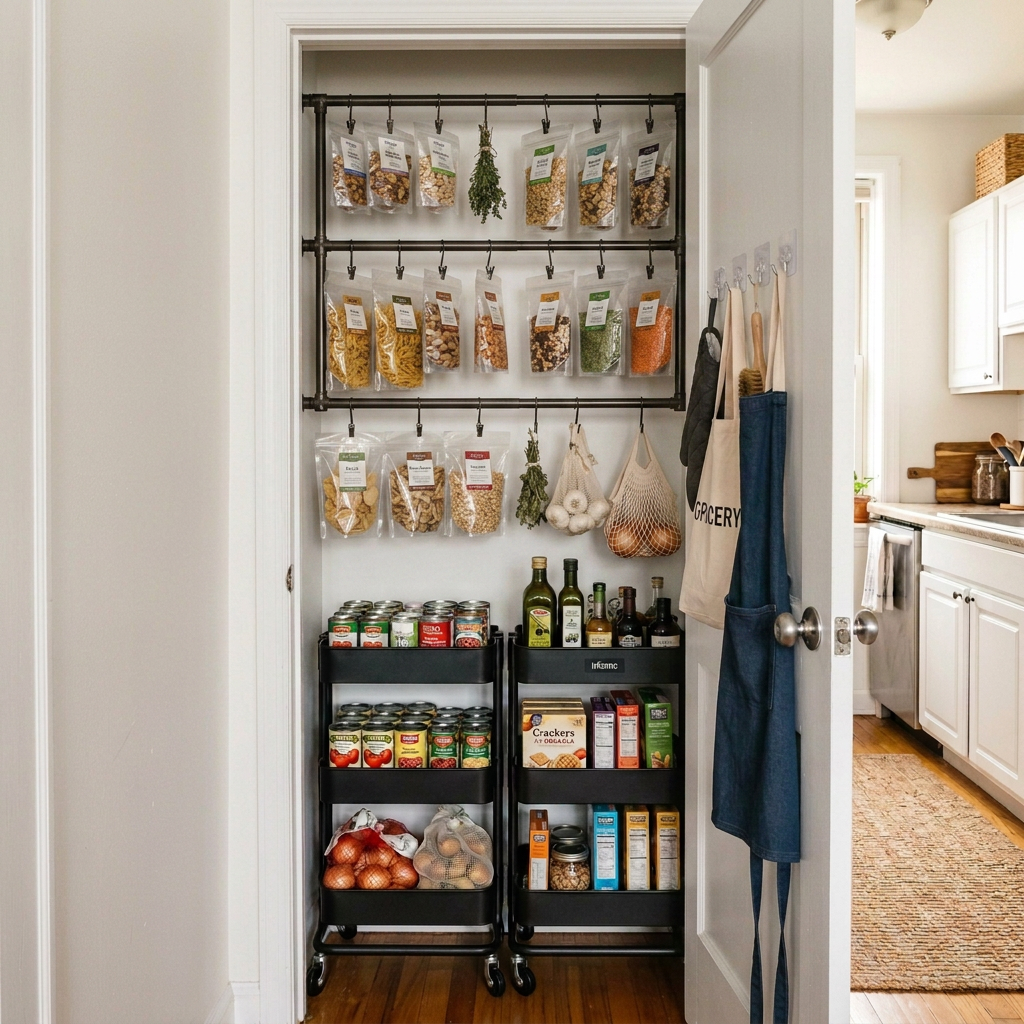
The first apartment I rented had a pantry the size of a phone booth and a lease that threatened to keep my deposit over a single nail hole which meant renter-friendly pantry organization wasn’t optional, it was survival..
Turns out most pantry organizing advice assumes you own the walls. Built-in shelving, mounted racks, anything that involves a stud finder. Fine if that’s your situation. Not fine if your landlord’s idea of “reasonable wear and tear” ends somewhere around a Command strip.
Renter-friendly pantry organization means using freestanding shelving, stackable bins, tension rods, and adhesive hooks instead of drilled or mounted storage. For big families, the priority shifts from “pretty” to “fast to restock and hard to disrupt,” with labeled zones that survive daily traffic and guest visits without collapsing into chaos.
Here’s the thing though once I gave up on wall-mounted anything, the pantry actually got more functional, not less. A drilled shelf is fixed. A freestanding cart moves when you need floor space for the folding table you drag out every time you host a specific holiday or gathering you host regularly.
Start With What Doesn’t Touch the Wall
Every renter-safe pantry system rests on the same three pieces, and none of them need a single screw.
A rolling cart solves the depth problem most rental pantries have narrow, deep, and impossible to see into past the second row. Wire or wood, doesn’t matter, as long as it’s on wheels. Stackable bins solve the volume problem: buying rice, flour, and lentils in bulk for a household of six or eight means you need containers that go up, not just across. And tension rods the kind meant for closets turn any shelf into two shelves for flat items like cutting boards or baking sheets, no hardware involved.
That’s genuinely it for structure the core of any renter-friendly pantry organization system.

The Zone System That Actually Survives a Big Family
I tried alphabetizing once. Lasted four days. Nobody in a big household actually cares that cumin comes before flour they care whether the thing they grab five times a day is within easy reach or buried behind the backstock.
Zones work better than categories for large households because they’re built around who’s reaching for what, not what the item technically is. A high-frequency zone at easy reach snacks, breakfast items, whatever gets grabbed daily without a chain reaction of falling boxes. A staples zone rice, oil, pasta, flour at prime eye level, because that’s what gets grabbed mid-recipe with wet hands and no patience. A backstock zone up top or down low, for the bulk-buy insurance policy every big family runs on.
Labels matter more here than in a two-person household, mostly because more hands means more people putting things back in the wrong spot. Removable labels the kind that peel clean off plastic bins keep the system legible without becoming another thing stuck to a rental surface you can’t fully strip later.

Hosting Changes the Math
Which brings me to the part nobody tells you: a pantry built only for daily family use falls apart the second you’re hosting fifteen people for a specific occasion you host, an iftar or a Sunday lunch rotation.
Hosting doubles or triples what needs to come out of that pantry in a single afternoon, and if your everyday system is optimized purely for grab-and-go breakfast, it collapses under bulk cooking. The fix isn’t a bigger pantry most renters don’t have that option anyway. It’s a designated “overflow” bin, empty by default, that exists only to hold the extra serveware, the backup spices, the disposable containers, the stuff that only appears three or four times a year. Keep it collapsible or nest it inside another bin the rest of the time, and it earns its shelf space without permanently eating into daily storage.
I also keep a small tray specifically for grab-and-set-out items the ones that go straight from pantry shelf to table when guests are due in twenty minutes. Sounds minor. Saves an embarrassing amount of scrambling.

What Not to Buy
Every “aesthetic pantry” photo you’ve seen involves buying the same brand of matching bin in bulk, and for a big family, that’s often the wrong call financially before it’s even the wrong call practically. Uniform containers look great for four people’s worth of pasta. They get expensive fast when you’re outfitting a pantry meant to feed eight.
What actually holds up: mismatched but functional containers, unified only by label style. According to the EPA’s guidance on plastic reuse, repurposing food-safe containers you already own is both cheaper and lower-waste than replacing an entire pantry’s worth of storage at once which, for a renter watching a budget stretch across more mouths, is the more honest starting point than a matching-bin haul.
Save the matching-container budget for the zones that actually get seen the high-frequency zone people open constantly, or the shelf visible from the kitchen doorway. Let the backstock zone be whatever containers survive. If your pantry is one corner of a bigger clutter problem, my post on storage solutions for maximalist homes covers the same “hide it in style” logic for the rest of the house.
The Adhesive Hooks Are Doing More Work Than You Think
Small detail, outsized impact: a strip of adhesive hooks inside the pantry door. Aprons, oven mitts, a small broom anything you’re grabbing multiple times a day but don’t want taking up shelf real estate. In a small rental pantry, the door is unused vertical square footage almost every family ignores until they run out of room everywhere else.
A note on the adhesive itself, since this is the one place renters actually get burned: cheap hooks fail under weight and cheap removal strips take paint with them. The FTC’s consumer guidance on product labeling is a useful reminder to actually read weight ratings before hanging anything heavier than a dish towel it’s a small check that prevents a much bigger security-deposit conversation.
If your household leans toward gatherings with a specific cultural or religious rhythm Ramadan prep, Eid hosting, a Sunday lunch that rotates through extended family the overflow bin above earns double duty. It’s the same bin, but the contents rotate seasonally: dates and specific pantry staples for one stretch of the year, disposable serveware for another. One bin, reused, rather than a permanent shelf given over to something used six weeks a year.

Renter-Friendly Pantry Organization: The Real Trade-Off
I won’t pretend a rental pantry ever stops feeling tight when you’re cooking for a crowd. The honest trade-off is this: freestanding, removable systems give up a little bit of maximum storage density compared to custom built-ins, in exchange for keeping your deposit and being able to take the whole system with you when the lease ends.
For most renters, friendly pantry organizationthat trade is obviously worth it. For a big family specifically, it’s worth it twice over because the system that survives a move also survives the chaos of a household that outgrows its space every few years anyway. If the pantry is sorted and you’re ready to tackle the rest of the kitchen, transforming your kitchen into a vibrant, eclectic space is the natural next step.
FAQ
Do I need special containers for a renter’s pantry, or can I reuse what I have?
Reusing food-safe containers you already own is the more budget-friendly and lower-waste option, especially for larger households. Save new, matching containers for the zones people see most often.
What’s the best approach to renter-friendly pantry organization for a large family without drilling?
Freestanding rolling carts, stackable bins, and tension rods create tiered storage without touching the walls, and organizing by “who reaches for what” (zones) works better than strict alphabetical or category systems when multiple people are using the space daily.
How do I keep my pantry ready for hosting without a bigger kitchen?
Keep one dedicated overflow bin, empty by default, for occasional-use items like extra serveware and backup spices. It only fills up when you’re hosting, so it doesn’t eat into everyday storage the rest of the time.
Are adhesive hooks actually safe for rental walls and cabinet doors?
Most are, if you check the weight rating before use and choose a removal-rated adhesive strip. Cheap hooks that exceed their rated weight are the more common cause of paint damage, not the adhesive itself.
Linda is a home décor enthusiast and the designer behind Linda Design Shop Co. She writes about beautiful interiors and creates bilingual wedding stationery for meaningful celebrations. You can browse the full collection at my Etsy shop, LindaDesignShopCo.