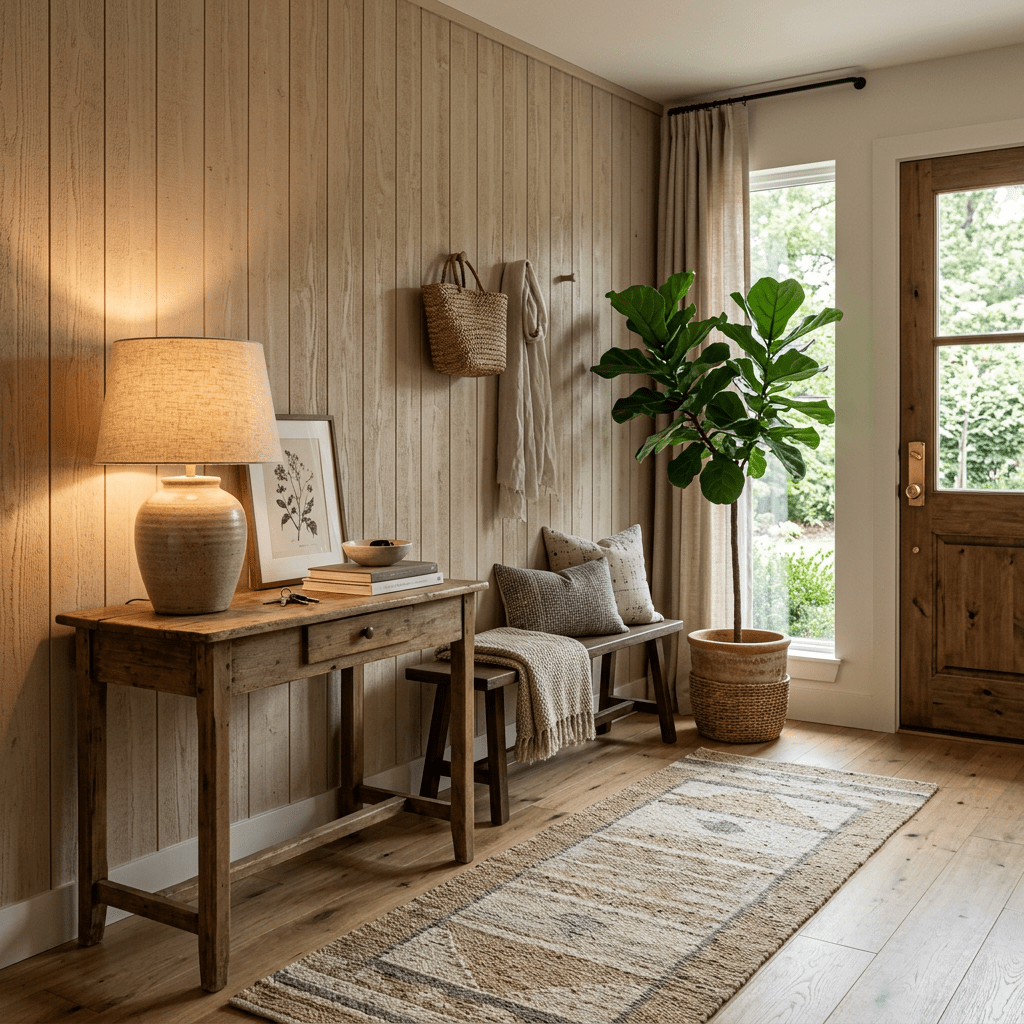
- Why Your Brain Needs a Physical Transition Not Just a Mental One
- The Four Sensory Layers of a Decompression Zone
- The Sensory Stack Matrix: Standard vs. Decompression Entryway
- Spatial Constraints Are Not an Excuse
- The Biophilic Argument: Why Plants Belong at the Threshold
- Designing the Ritual, Not Just the Room
- Extending the Logic: From Threshold to Sanctuary
- The Most Underrated Room in Your Home
Sensory Design · Wellbeing · Entryway
What if walking through your front door actually worked not as a commute endpoint, but as a nervous-system reset?
There’s a moment that happens every single day, and most of us blow right past it. The key turns. The door swings open. And we carry our 9-to-5 cortisol load the fluorescent lights, the open-plan noise, the unread pings directly onto our couch, our dinner table, our sleep.
The problem isn’t stress itself. It’s the absence of a boundary. A physical, sensory, ritual-rich signal that tells the brain: that world is done. This one begins now.
That’s the threshold effect. And it’s very much something you can design. In this piece, I’m going deep on sensory entryway design for anxiety relief what the science says, what actually works in small and rental-restricted spaces, and how I’d layer it all together. This isn’t about buying a pretty console table. It’s about creating genuine psychological architecture at your own front door.
Why Your Brain Needs a Physical Transition Not Just a Mental One
Neuroscience has a name for what we’re designing: an environmental cue cluster. The brain doesn’t switch modes on command. Tell yourself to “relax now” all you like your amygdala isn’t listening. What it does respond to is multi-sensory pattern recognition. A consistent set of inputs light, scent, sound, texture that reliably precede a restful state trains the nervous system to begin downregulating automatically as you cross that threshold.
Think of Pavlov, but make it your foyer.
The research on environmental transitions is surprisingly rich. Research published in the Journal of Environmental Psychology demonstrates that physical “boundary experiences” moments of moving through a spatial divider function as genuine cognitive reset points, interrupting task-related rumination loops and reducing perseverative thinking. Gabriel, Perez, and Harber’s work on “new environment” mental shifts further confirms that spatial transitions create measurable breaks in working memory load. When those moments are deliberately designed rather than accidental, their efficacy multiplies. You’re essentially programming a biological off switch into your architecture.
“The entryway isn’t decoration. It’s the first sentence of a completely different story your nervous system needs to hear.”
This is also why the fractal patterns I explored in this piece on the 60% stress rule matter so much in transitional spaces the brain recognizes nature-derived geometry faster than it processes linear, man-made shapes, triggering parasympathetic tone within seconds of visual contact. Your entryway is prime real estate for that effect.
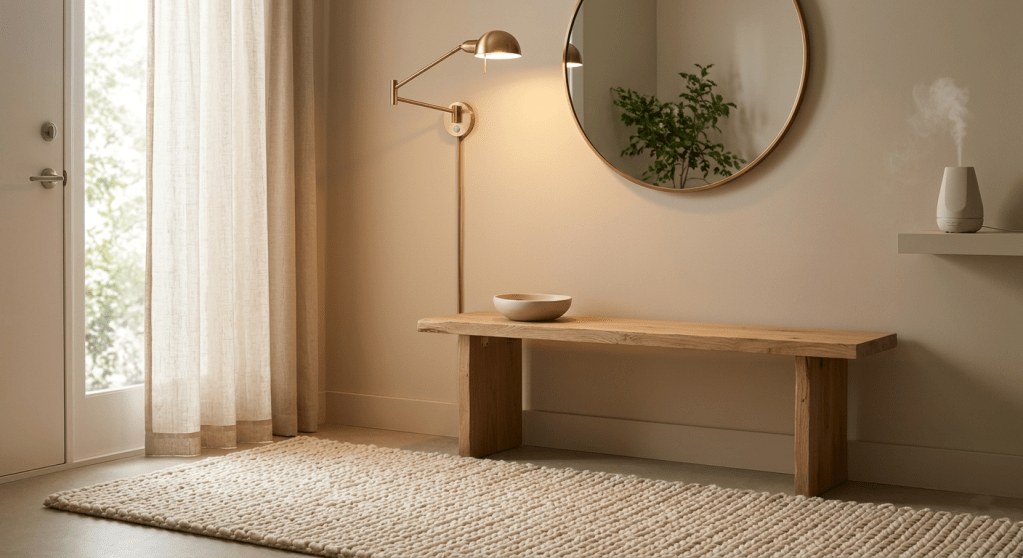
The Four Sensory Layers of a Decompression Zone
A truly effective decompression entryway doesn’t rely on one element. It builds a sensory stack each layer reinforcing the others until the brain has no choice but to exhale.
Layer 1: Sound — Silence the Echo, Change the Acoustic Story
Hard entryways are acoustic nightmares. Tile, bare walls, hollow doors everything bounces. That reverb doesn’t just sound bad. It actually maintains physiological arousal. Diffuse, reverberant environments keep your auditory cortex on alert.
The solution? Acoustic absorption at the threshold. And here’s where renters and apartment dwellers tend to freeze up, they assume acoustic treatment means ugly foam pyramids or expensive built-ins. Not even close.
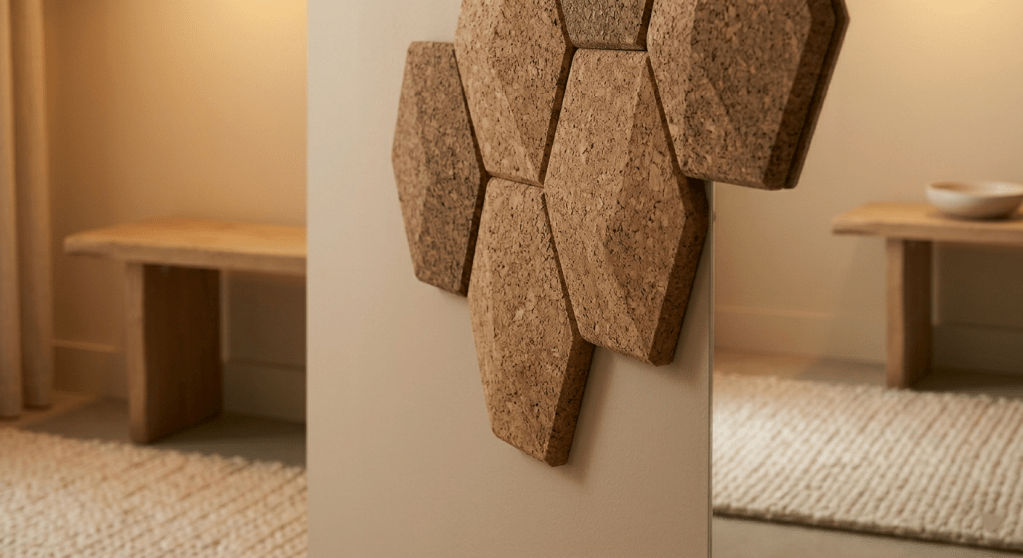
Aesthetic acoustic wall panels for renters have quietly become one of the most interesting intersections of design and function in the last few years. Woven wall hangings in thick wool or boucle, fabric-wrapped frames with hidden acoustic batting, cork panels in geometric arrangements, felt sculpture these are genuinely beautiful objects that happen to absorb sound. Command strips, picture rail hooks, tension rod systems: none of them require a drill into your landlord’s walls.
Renter-Friendly Acoustic Panel Ideas
→ Gallery-hung fabric panels using adhesive picture rails swap seasonally, no damage.
→ Large macramé or woven wall pieces in chunky natural fibers thick weaves absorb mid-high frequencies beautifully.
→ Cork hexagon tiles with temporary mounting tape also doubles as a pinboard for your “shed the day” ritual notes.
→ A full-length fabric curtain across one wall adds texture, warmth, absorbs sound, and costs almost nothing to remove.
The goal isn’t a recording studio. It’s a deadening of ambient echo just enough that when you close that door behind you, the acoustic environment literally shifts. Your ears register it. Your nervous system follows.
Layer 2: Light — Dimmer, Warmer, Slower
Office environments are calibrated for productivity: cool, bright, blue-spectrum light. Your decompression zone should be their exact opposite. Warm amber tones think 2700K or lower signal the brain that the day is winding toward its biological close.
A smart bulb on a motion-activated warm setting means the moment you step inside, the light automatically does the work. No switch to remember, no behavioral burden. I’ve written extensively about sensory regulation strategies in outdoor and transitional spaces and light temperature is consistently the highest-leverage, lowest-effort intervention available. Wall-mounted uplighters, a salt lamp on a timer, candles arranged near the entrance for evenings all of these reframe the space visually before your coat is even off.
Layer 3: Scent — The Fastest Neurological Bypass
Olfactory input reaches the limbic system the brain’s emotional processing center faster than any other sense. There’s no thalamic relay, no cortical detour. Scent hits the amygdala almost directly. This is why certain smells trigger instantaneous emotional states with zero conscious thought.
Design this deliberately. A reed diffuser by the door with lavender or bergamot. A small wax melt warmer on a low-set timer that activates thirty minutes before your usual return. The consistency matters as much as the scent itself over time, that smell becomes a conditioned cue for relaxation. Your body starts downregulating before you’ve consciously registered the transition.
Keep it subtle. Overpowering fragrance creates sensory overwhelm the opposite of what you want. Think hint, not announcement.
Layer 4: Touch + Texture — The Grounding Ritual
This is the most underestimated layer. Physical sensation specifically, the act of changing what you’re touching is one of the most reliable ways to interrupt a stress loop.
A thick, high-pile entryway rug. A wooden bench with a slightly rough-hewn surface. A smooth ceramic bowl for your keys. A linen apron or soft throw draped invitingly near the door. These aren’t aesthetic choices (though they are that too). They’re tactile anchors objects designed to be touched as part of a micro-ritual. Remove your shoes on a textured mat. Run your hands along natural wood. Feel something other than a keyboard.
The ritual doesn’t need to be elaborate. Even 90 seconds of intentional sensory engagement at the threshold is enough to begin shifting your neurological state. The design creates the invitation. You just have to accept it.
Visualizing Information Gain
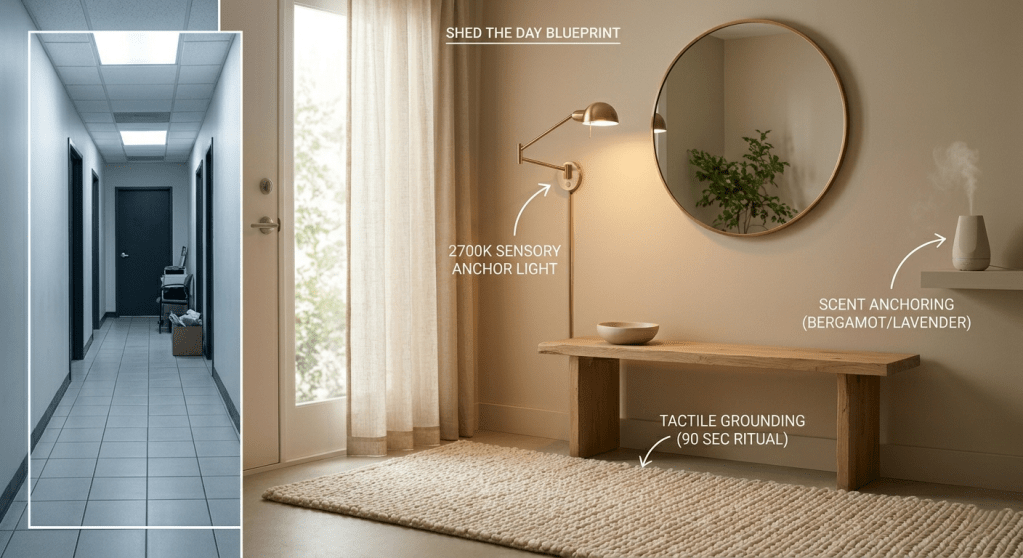
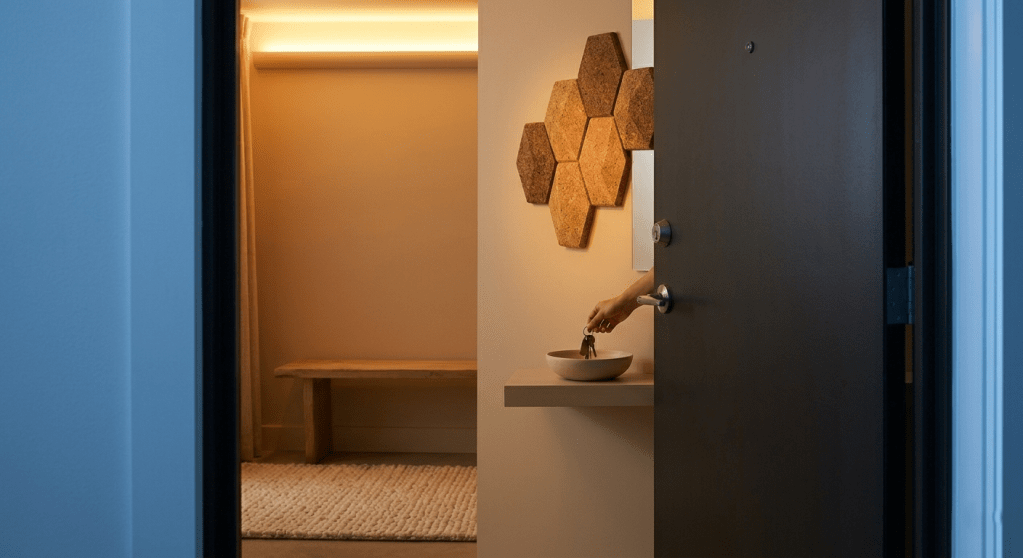
Figure 1: The Master Decompression Zone Blueprint. By actively countering a clinical, over-stimulated workspace corridor (left) with a neuro-aesthetic sensory sequence (right), your threshold operates as an automated neurological break point.
Quick-Reference Guide
The Sensory Stack Matrix: Standard vs. Decompression Entryway
| Sensory Input | Standard Stress-Inducing Entryway | Neuro-Aesthetic Decompression Alternative |
|---|---|---|
| 🔊 Acoustics | Bare walls, tile floors, echoing street noise | Felt art pieces, thick-woven macramé, sound-deadening curtains |
| 💡 Lighting | Cool-spectrum overheads (3500K–4000K) | Motion-activated warm amber panels or sconces (2700K or lower) |
| 🌿 Olfactory | Stale air, lingering kitchen or outdoor odors | Continuous subtle reed diffusers: bergamot, lavender, cedar |
| ✋ Tactility | Hard plastics, cold metal keys on bare glass | High-pile rugs, raw-edge wood benches, ceramic drop trays |
Spatial Constraints Are Not an Excuse
Let me be direct: most of us don’t have a grand foyer. We have a narrow corridor, a flat entrance with no defined “entry,” or an apartment door that opens directly into a living space. None of this disqualifies you from the threshold effect. It just requires lateral thinking.
Creating a Zone Where None Exists
In open-plan apartments, zone definition happens through furniture placement, area rugs, and vertical elements rather than walls. A freestanding shelf acting as a divider. A dramatic pendant light hung specifically above the entry point. A rug that begins at the door and ends with intentional clarity marking the edge of the decompression zone.
Even a narrow corridor of 80cm can hold:
- One acoustic panel or textured wall hanging
- A scent element at nose height
- A small warm-light fixture (plug-in sconce, no electrician needed)
- A tactile rug underfoot
That’s a full sensory stack in a space roughly the width of a doorway. Vertical is your best friend in constrained entries work the walls, not the floor plan.
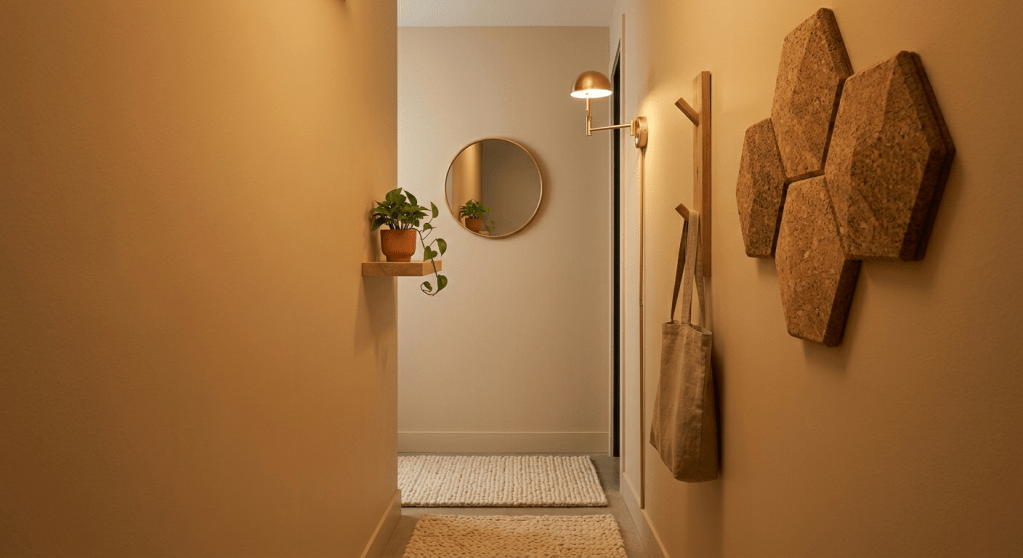
The Renter’s Toolkit
Rental constraints kill more good designs than any budget ever has. But the aesthetic acoustic wall panels for renters category has expanded enormously and the same renter-friendly logic applies across all four sensory layers. Removable wallpaper for visual texture and warmth. Plug-in wall sconces instead of hardwired fixtures. Freestanding coat racks doubling as sculptural elements. Tension-mounted shelving. Peel-and-stick cork tiles for both sound and visual interest.
The philosophy is reversible permanence: create an environment that feels fully committed and intentional, while leaving zero trace when you leave. This is entirely achievable. It just requires knowing which products are worth the investment.
The Biophilic Argument: Why Plants Belong at the Threshold
There is compelling research showing that even brief visual contact with live plants measurably reduces cortisol levels. Thirty seconds of exposure. Not a meditation, not a yoga practice just seeing something green and alive.
Placing a plant at the threshold is not just decorative. It’s a cortisol intervention. A trailing pothos on a high shelf. A structural snake plant framing the doorway. A small arrangement of eucalyptus that doubles as air-refreshing aromatherapy — which connects neatly to natural air quality improvements that don’t require expensive purifiers.
Rooted in Terrapin Bright Green’s industry-standard 14 Patterns of Biophilic Design framework — specifically Pattern 1 (Visual Connection with Nature) and Pattern 7 (Presence of Water and Living Systems) — nature-derived stimuli trigger a hardwired parasympathetic response. Fractal light, plant forms, organic textures, living scents: these aren’t aesthetic preferences. They’re evolutionary signals your nervous system has been reading for 300,000 years. Your entryway is the first place in your home. Make it undeniably, visibly, texturely alive.
And if your entryway gets low light? Don’t fake it with plastic choose shade-tolerant species like ZZ plants, cast iron plants, or a trailing philodendron, or invest in a small grow light styled as a design element. The signal still lands.
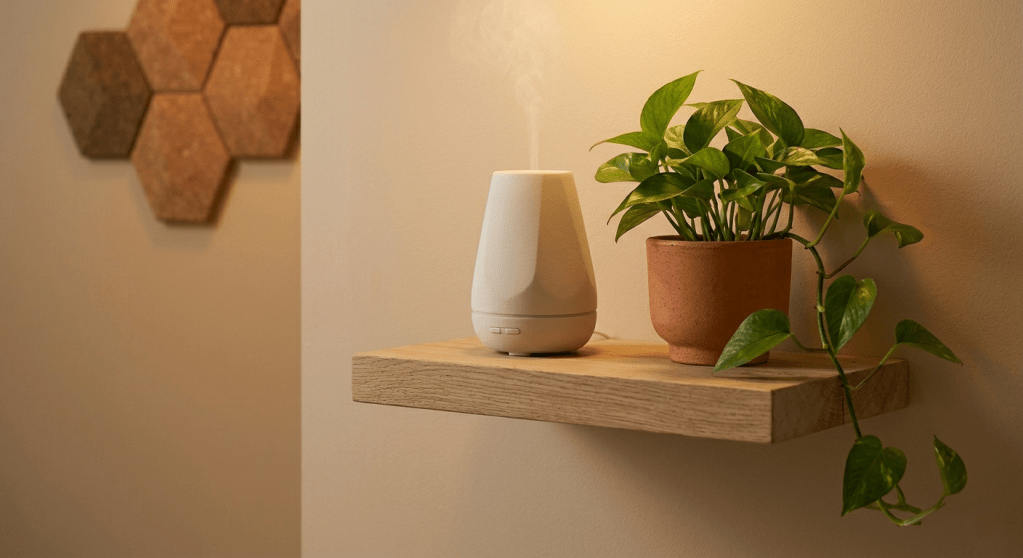
Designing the Ritual, Not Just the Room
Here’s the part most interior design articles skip entirely. The sensory environment creates the container. But the ritual is what gives it meaning and meaning is what makes it neurologically sticky.
What a Decompression Ritual Looks Like
It doesn’t need to be complicated. Five minutes, maximum. The structure:
Enter slowly. Pause at the threshold before moving inward. Consciously note one sensory detail: the scent, the warmth of the light, the texture underfoot. This interrupts the automatic carrying-of-stress from outside world to inside space.
Change your body. Remove shoes. Change clothes if you can. Physical transformation is not trivial it signals a state shift to the nervous system. Shoes are extraordinary carriers of “outside world” energy, psychologically speaking. Their removal is a literal unburdening.
Place something down. Keys in the bowl. Bag on the hook. Phone on the tray, face-down. Each object placed is a micro-release. You’re not just organizing, you’re offloading.
Take one breath. Just one long exhale before moving into the rest of your home. The extended exhale activates the vagus nerve, triggering parasympathetic response. It takes four seconds. It is absurdly effective.
This is the ritual your designed threshold makes possible. Without the sensory environment, it’s just a hallway. With it, you’ve built a genuine nervous-system reset into your daily life.
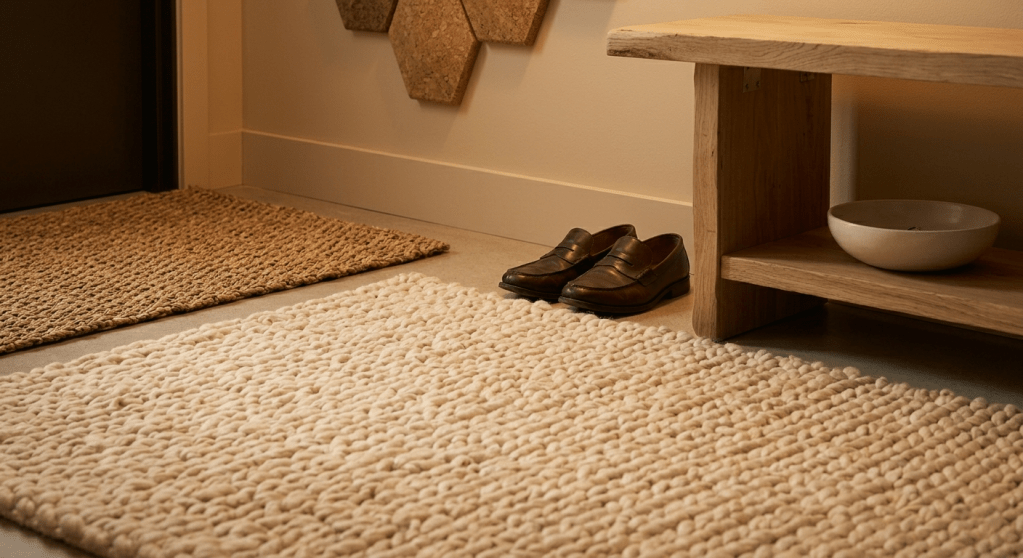
Extending the Logic: From Threshold to Sanctuary
The decompression zone doesn’t have to end at the entryway. Think of it as the first layer of a whole-home sensory regulation strategy. The same principles acoustic softening, biophilic layering, warm light, scent anchoring can extend outward from your threshold into transitional corridors, reading nooks, and ultimately into spaces designed for deep rest.
If you have outdoor access even a small balcony the decompression logic is incredibly powerful there too. I explored this at length in the guide on designing small outdoor spaces specifically for sleep health and sensory restoration, where even 50 square feet can become a meaningful transitional space between the outside world and your sleep environment.
The idea is continuity of intention. Your home doesn’t begin at your living room. It begins at your door. Design accordingly, and you’ll find that the rest of the space the kitchen, the bedroom, the places you’re meant to truly rest carries the benefit of a nervous system that arrived there already halfway there.
The Most Underrated Room in Your Home
We obsess over kitchens and bedrooms. We invest in living rooms. The entryway gets a coat hook and a forgotten umbrella.
But think about the math. You cross that threshold 365 days a year. Twice a day, at minimum. That’s 730 opportunities to either carry the stress of the outside world inward or to shed it at the door. Multiply that by years. By decades. The design of that six square feet may matter more to your long-term wellbeing than almost any other design decision in your home.
Sensory entryway design for anxiety relief isn’t a luxury category. It’s a daily neurological practice made physical. And unlike meditation apps or therapy schedules, it works passively every single time you come home, whether you’re in the mood or not.
Start with one layer. A rug. A warm-toned bulb. A plant. A single acoustic panel hung with tension wire. See how your body responds. Then build from there.
The threshold is waiting. Cross it differently.
© 2026 Linda Designs · Home Decor, Interior Design & Lifestyle Inspiration. All rights reserved.
 Linda Designs | Home Decor, Interior Design & Lifestyle Inspiration