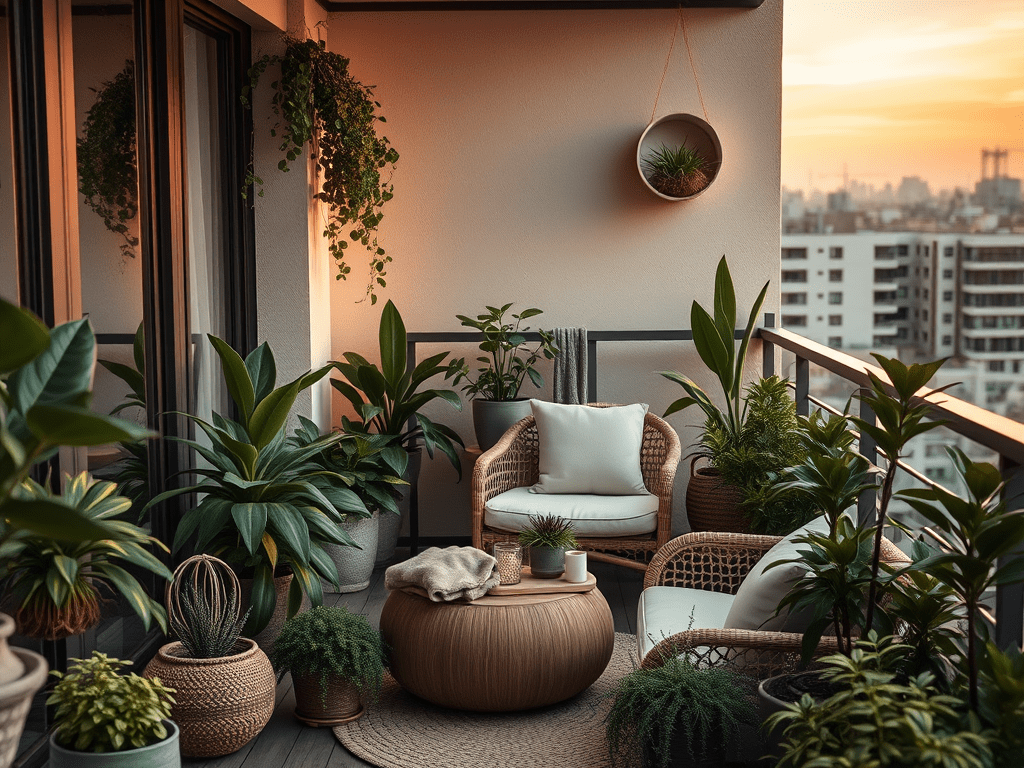
- Why Your Balcony Is a Sleep Tool You’re Ignoring
- The Best Plants for Bedroom Balcony Air Quality (and Sleep)
- Designing Your 50sqft Oxygen Balcony: A Zone-Based Approach
- Materials That Work With Your Nervous System, Not Against It
- The Lighting Protocol That Actually Prepares You for Sleep
- The 15-Minute Oxygen Balcony Ritual: Making the Design Work
- The 5 Biggest Small Balcony Design Mistakes (That Ruin Sleep Health Benefits)
- Building Your Oxygen Balcony on Any Budget
- ❓ Frequently Asked Questions
- 📚 References & Further Reading
Your tiny urban balcony might be the single most underutilized wellness tool in your home. Here’s how to change that.
Fifty square feet. That’s roughly the size of a large closet, a small bathroom, or and this is what I want you to sit with for a moment the exact amount of outdoor space it takes to completely transform how you sleep.
Most urban dwellers look at their balcony and see limitation. A concrete ledge. A place to stack unused furniture. A smoker’s corner that became a plant graveyard. But sleep researchers, environmental psychologists, and biophilic designers are increasingly pointing to these neglected micro-spaces as genuinely powerful levers for sleep health and the science is more compelling than you’d expect.
“Honestly? This is the conversation I’ve been wanting to have for so long. Because I’ve been obsessing over home design and sleep spaces for years now reading the research, testing ideas in my own home, dragging friends through balcony makeovers they didn’t ask for and the one space that keeps coming up as criminally underused is always the same.
Not the mattress. Not the blackout curtains. Not even the bedroom itself. It’s that little outdoor strip just outside the window that most of us are basically using as a sad plant cemetery. And I genuinely cannot stop thinking about the potential sitting right there, untouched, in just 50 square feet.”
- 30% Improvement in sleep quality linked to increased nature exposure before bed (APA, 2022)
- 21.3% Reduction in cortisol levels after just 20 minutes in a plant-rich outdoor environment
- 50ft² Minimum effective footprint for a functional “oxygen balcony” sleep zone
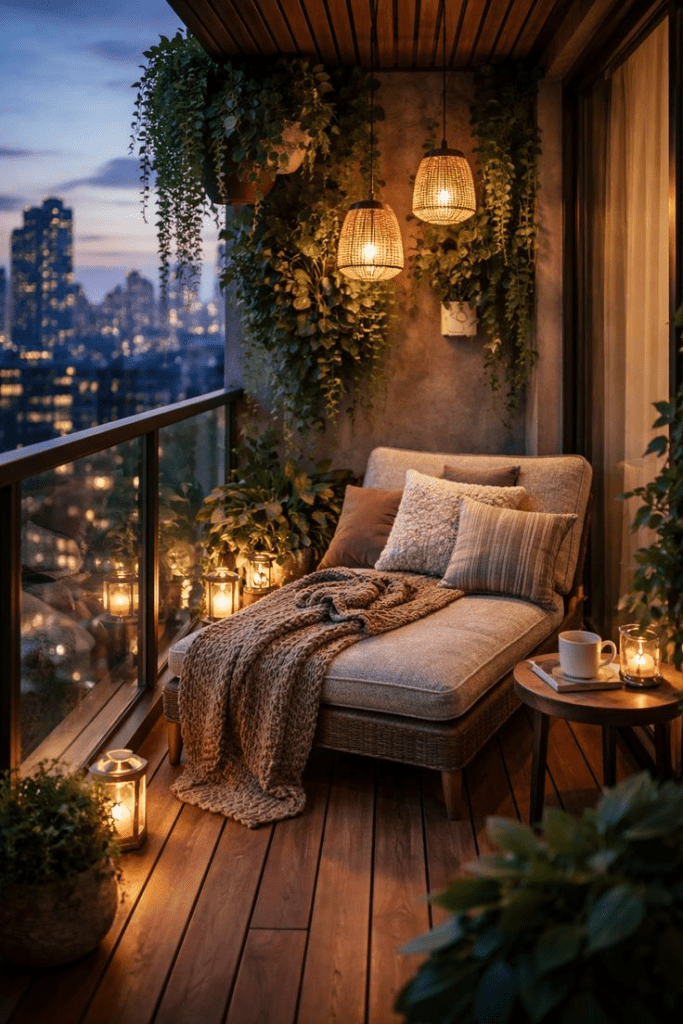
Why Your Balcony Is a Sleep Tool You’re Ignoring
Sleep is not just a bedroom problem. It begins hours before you lie down in your cortisol levels, your body temperature, your exposure to natural light, and the air you’ve been breathing all evening. Your balcony, if designed intentionally, can influence every single one of those variables.
Here’s the thing that surprises people. It’s not about having a huge space. It’s about having the right space. A curated 50sqft balcony with the right plants, lighting, materials, and sensory design cues can trigger what physiologists call a “pre-sleep parasympathetic shift” essentially, the biological handover from alert daytime mode to restful nighttime mode.
“The transition from indoor to outdoor even briefly resets the nervous system in ways that four walls simply cannot replicate.”
This is partly about air. Fresh, slightly cooler outdoor air lowers core body temperature, which is one of the most reliable physiological signals for sleep onset. It’s also about light natural twilight exposure in the evening recalibrates your circadian rhythm far more effectively than any smart bulb. And it’s about sensory richness: the sound of leaves, the texture of natural materials, the scent of certain plants. All of it sends your brain one clear message: it’s safe. Slow down. Rest.
📖 Related on Linda Designs
I’ve written extensively about how to use your morning and evening routines as sleep anchors. If you haven’t already, check out these decor tricks for stress-reducing morning routines many of the same principles apply directly to balcony design.
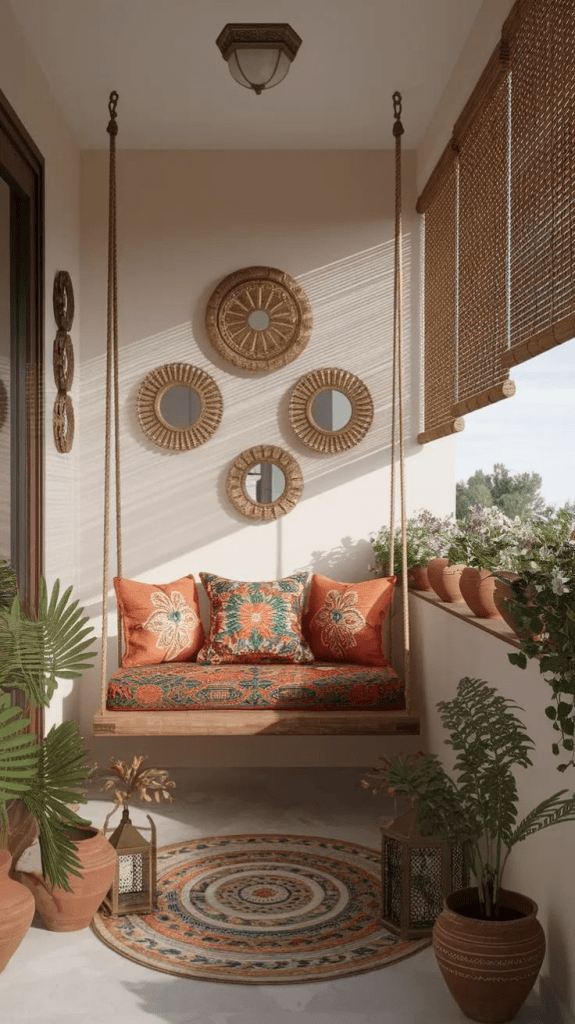
The Best Plants for Bedroom Balcony Air Quality (and Sleep)
Let’s get specific. Because “put some plants out there” is advice so vague it’s almost useless. The plants you choose for a sleep-focused oxygen balcony should do three distinct jobs: actively improve air quality, produce calming scents, and crucially thrive in the outdoor conditions your balcony actually has.
Oxygen-Producing Powerhouses for Small Balconies
Most plants exchange oxygen and CO₂ during the day via photosynthesis and then switch to respiration at night consuming small amounts of oxygen. But a handful of species actually continue releasing oxygen after dark, making them ideal for a bedroom-adjacent balcony.
Snake Plants (Sansevieria) are the most famous example. Areca Palms are another. Both are extraordinarily tolerant of the kind of inconsistent watering that balcony life demands.
Spider plants are chronically underrated. They are ruthless air purifiers, capable of reducing airborne formaldehyde and benzene compounds that off-gas from synthetic furnishings and urban air and they multiply freely, filling a small railing planter in a single season.
| Plant | Air Quality Benefit | Sleep Benefit | Light Needs |
|---|---|---|---|
| Lavender | Reduces airborne bacteria | Lowers heart rate & anxiety (linalool) | Full sun |
| Snake Plant | Releases O₂ at night | Improves overnight air quality | Low–bright indirect |
| Jasmine | Mild antimicrobial scent | Linked to deeper, less disturbed sleep (Wheeling Jesuit study) | Partial–full sun |
| Areca Palm | Humidifies dry air, removes toxins | Better humidity = easier breathing during sleep | Bright indirect |
| Spider Plant | Removes formaldehyde & CO | Cleaner air reduces sleep disruption | Indirect light |
| Gardenia | Light natural fragrance | Studied as a natural sedative alternative | Bright indirect |
| Valerian | Minimal air purification | Root scent shown to reduce time to sleep onset | Full sun |
🌿 Designer Tip
For a 50sqft balcony, aim for 6–9 plants in varying heights: two tall statement plants (areca palm or snake plant in tall pots), three medium aromatic plants (lavender, jasmine on a small trellis), and three trailing or railing plants (spider plant, pothos, rosemary). This creates a layered “canopy effect” that maximises air quality and sensory richness without visual clutter.
📖 Go Deeper on Linda Designs
If you’re serious about cleaning the air in and around your home naturally, don’t miss my science-backed guide on 8 free ways to improve home air quality without purifiers it covers both indoor and transitional spaces, and several of the methods pair beautifully with a balcony oxygen zone.
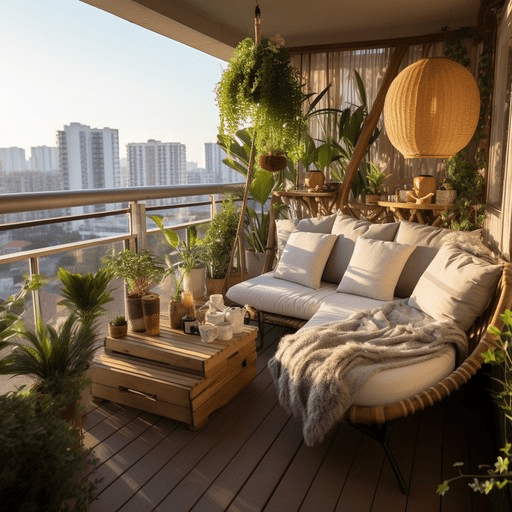
Designing Your 50sqft Oxygen Balcony: A Zone-Based Approach
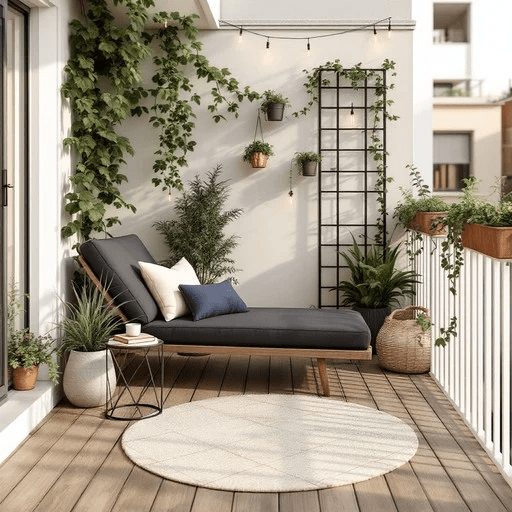
Here’s where most small balcony guides go wrong: they treat the space as a miniature patio. Chairs, a table, some string lights. It looks nice. It doesn’t change how you sleep. For genuine sleep health benefits, your balcony needs to be designed around a specific sequence of use and that requires thinking in zones, even in a space this small.
The Three Zones of a Sleep-Focused Balcony
🪴Zone 1: The Air Layer (60% of space)
Plants, planters, and a railing-mounted vertical garden. This is your oxygen engine. Prioritise fragrant and air-purifying species here. Keep it lush but not crowded air circulation matters.
🪑Zone 2: The Decompression Seat (25% of space)
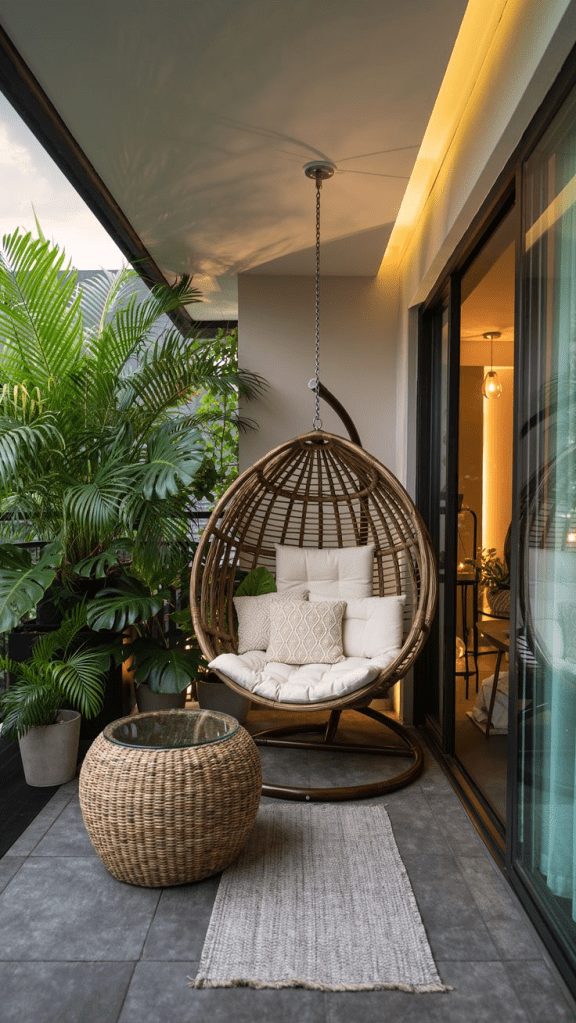
One seat. Just one. A low reclining chair or hammock chair works brilliantly in tight spaces. Facing the plants, not the street. The psychological cue of sitting within the greenery, not next to it, is important.
💡Zone 3: The Lighting Anchor (15% of space)
Warm, low, amber-toned lighting only. A solar lantern, a single string of 2700K warm bulbs. No blue light whatsoever. This zone signals twilight to your circadian system and begins melatonin production.
🌊Bonus: Sound Layering
If street noise is an issue, a small water feature or wind chimes in the 400–800Hz range can mask urban sounds with what researchers call “pink noise” shown to increase deep sleep stages by up to 23%.
The key is intentionality. Every element you place on this balcony should be answering one question: does this help me wind down? If the answer isn’t yes, it doesn’t belong there. That means no work equipment, no harsh overhead lighting, and absolutely no scrolling save that for inside.
📖 From the Linda Designs Archive
Biophilic design isn’t just a trend it’s one of the most evidence-backed approaches to stress reduction in the home. My post on 5 biophilic design elements that actually reduce stress (according to science) is essential reading alongside this one, particularly the sections on natural materials and fractally complex patterns.
Materials That Work With Your Nervous System, Not Against It
The physical materials of your balcony matter enormously and this is a dimension that almost no one considers when designing a small outdoor space. Smooth concrete. Metal railings. Plastic chairs. These materials are thermally harsh, acoustically reflective, and visually stark. They do the opposite of relaxing you.
Natural Materials for a Calming Outdoor Space
Teak or acacia wood decking, even in tile-form, changes the thermal and tactile experience of the space completely. Your bare feet land on something warm and organic. That single sensory shift from cold hard tile to warm wood grain measurably reduces physiological stress markers.
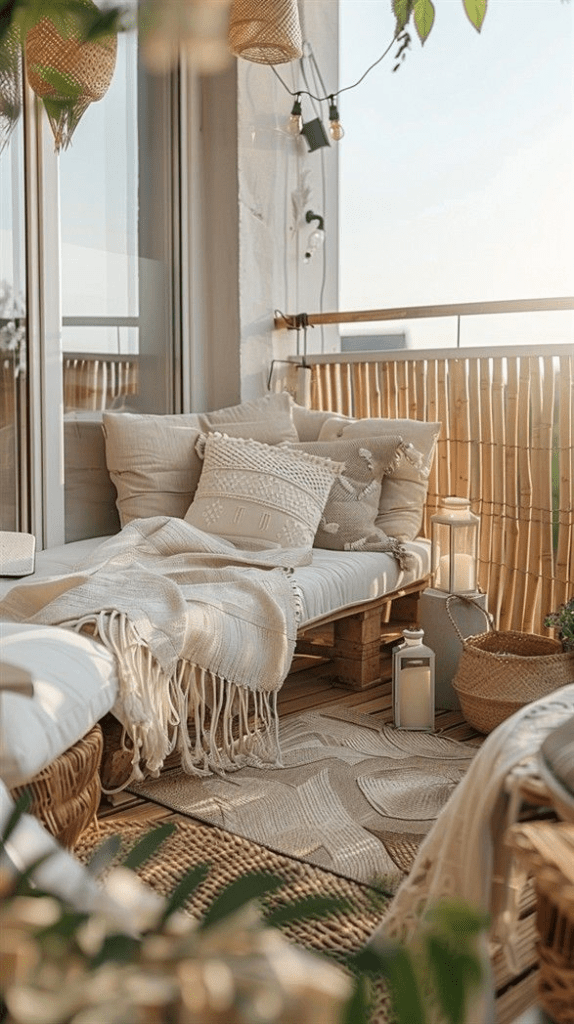
Rattan furniture absorbs heat rather than radiating it. Natural fibre rugs (jute, sisal, or outdoor-rated cotton) add acoustic softness to what is otherwise a hard-surface echo chamber.
Textiles are underused on balconies because people worry about weather damage. Valid concern. But outdoor-rated linen blends, solution-dyed acrylics (Sunbrella and similar), and UV-stabilised cotton canvas are completely viable for year-round exposure in most climates.
A single cushion. A lightweight throw draped over the chair back. These aren’t decorative indulgences they’re sensory anchors that help your body interpret the space as safe, soft, and restorative.
⚡ Science Note
Research in environmental psychology consistently shows that surfaces with natural variation wood grain, stone texture, living plant foliage engage the brain’s default mode network (the “rest and digest” neural state) far more effectively than uniform synthetic surfaces. This is why a 50sqft balcony with organic materials can outperform a 200sqft terrace of smooth poured concrete in terms of genuine relaxation response.
The Lighting Protocol That Actually Prepares You for Sleep
I want to be blunt here: the wrong balcony lighting will completely undermine every other sleep-positive design decision you make. Most people understand that blue light from screens disrupts melatonin. Fewer people apply this logic to their outdoor lights.
What to Use (and What to Absolutely Avoid)
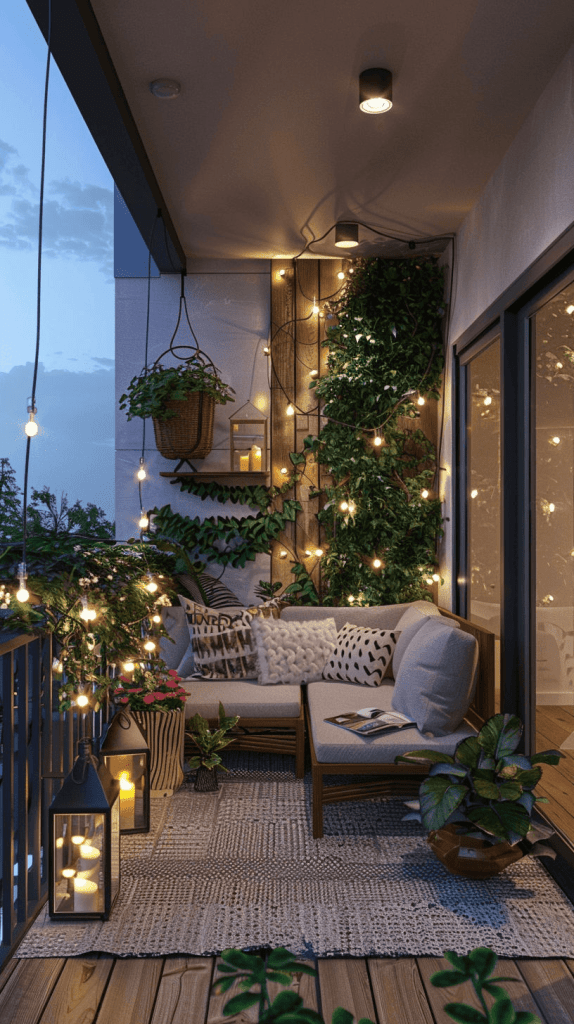
The goal is to mimic natural twilight. Think amber. Think low. Think warm. Solar-powered lanterns with candle-flame LEDs are genuinely excellent for this no installation, weather-resistant, and they automatically dim with the ambient light. String lights should be 2200K–2700K maximum. Anything whiter than that is working against your circadian system.
Avoid spotlights. Avoid overhead flood lights. Avoid any light that points upward toward your face. The direction matters as much as the colour temperature downward-cast warm light signals evening in a way that upward or sideways light simply doesn’t.
If privacy screening is part of your balcony setup, backlit frosted panels in warm amber can serve double duty as both a visual barrier and a circadian-friendly ambient light source.
📖 Also Worth Reading
If you’re building a whole-bedroom sleep sanctuary beyond just the balcony, my article on 5 daily mindfulness habits to start in the bedroom gives you a complete sensory and behavioural framework that works seamlessly with an oxygen balcony ritual.
The 15-Minute Oxygen Balcony Ritual: Making the Design Work
Here’s the thing about design: it only works when it’s used. The most perfectly designed oxygen balcony in the world will do absolutely nothing for your sleep if you collapse onto your sofa every evening instead.
The ritual is simple. Brutally simple, actually. Fifteen minutes. No phone. Between 8pm and 10pm your personal sweet spot will depend on your chronotype, but the key is consistency. Step onto the balcony. Sit. Breathe.
Let the amber light, the plant scent, the cooler air, and the natural soundscape do their work. That’s it. No meditation app required. No breathwork protocol. Just presence in a space that’s been engineered to support rest.
The compound effect of this practice over two to three weeks is genuinely remarkable. Not because the balcony is magic. But because you’re repeatedly sending the same neurological signal at the same time each evening: the day is over, the body can begin its descent into sleep. Circadian rhythms love repetition. They strengthen with it.
“The 15-minute oxygen balcony ritual is arguably the highest-ROI sleep intervention available and it doesn’t cost a single subscription.”
The 5 Biggest Small Balcony Design Mistakes (That Ruin Sleep Health Benefits)
1. Overcrowding the Space
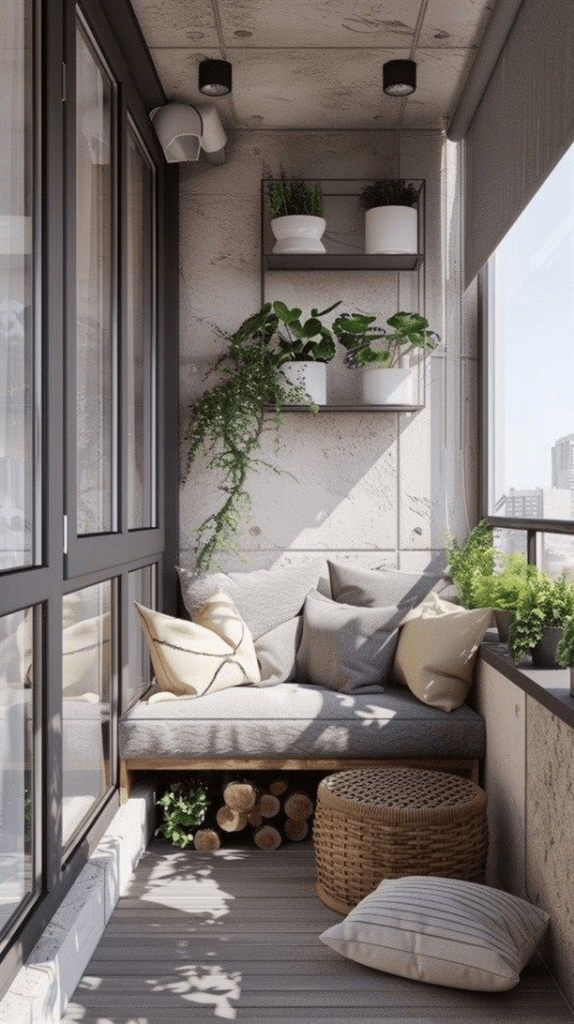
More plants does not equal more oxygen. It equals visual clutter, which activates the brain’s threat-detection system (the amygdala) rather than quieting it. Curate ruthlessly. Eight plants done well beats twenty plants done poorly every single time.
2. Choosing Purely Decorative Plants
If your balcony is filled with succulents because they’re on trend, I’m not going to apologise for saying: for sleep health purposes, most succulents are doing very little work. Prioritise the air-quality and scent-producing species in the table above, and let aesthetics follow function.
3. Using Bright or Coloured Lighting
Cool white solar lights. Blue-tinted LEDs. Edison-style bulbs marketed as “warm” that are actually 3500K. These will suppress your melatonin as effectively as your phone screen. Check the colour temperature before you buy. Always.
4. Making It a Multi-Purpose Space
A sleep balcony cannot also be a storage balcony. Or a work balcony. Or a place where you keep your bike. The brain associates spaces with activities. The moment you open your laptop on your rest balcony, you’ve contaminated it cognitively speaking with wakefulness associations.
5. Ignoring the View Axis
What your seat faces matters enormously. If you sit down and the primary view is a wall, a busy road, or your neighbour’s window, the parasympathetic system will not engage properly. Use vertical plant screens, bamboo or reed privacy panels, or tall potted grasses to frame a “green view” from your seat even if it’s an entirely constructed one.
Building Your Oxygen Balcony on Any Budget
You don’t need to spend thousands. Genuinely. A functional 50sqft oxygen balcony can be assembled for under €200–$200 if you’re strategic. Here’s how to think about it:
Prioritise plants first. Six well-chosen plants from the table above (lavender, jasmine, snake plant, spider plant, areca palm, gardenia) will run $50–$80 from a garden centre or market.
- Railing planters and basic terracotta pots add another $30–$40.
- A single second-hand rattan or outdoor chair: $30–$60 from Facebook Marketplace, Vinted, or a charity shop.
- Warm solar string lights: $15–$25.
- A weather-resistant outdoor rug: $20–$40.
- Total: approximately $145–$205 for a fully functional oxygen balcony. The ROI, measured in quality sleep? Priceless is a cliché, but it applies here.
✨ Linda’s Personal Note
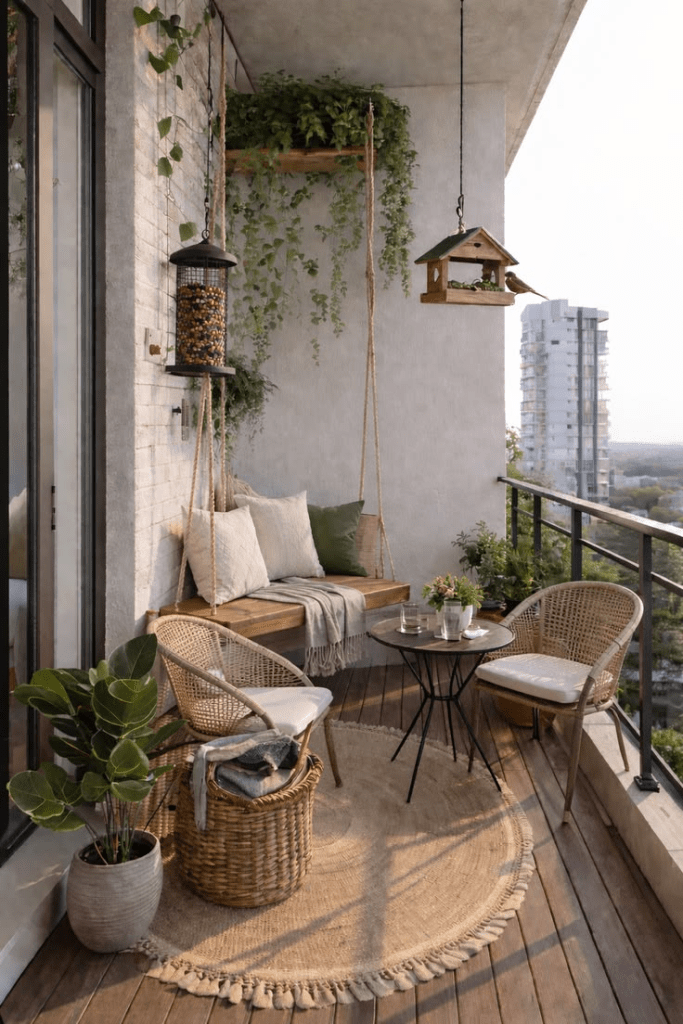
My own bedroom balcony is exactly 4.5 metres by 1.2 metres about 54sqft. I reshaped it 6 years ago using exactly the principles in this article, and the most frequent comment from guests is: “I feel calmer just standing here.” That’s the design working. That’s what 50 intentional square feet can do.
Your Sleep Transformation Starts Outside
The oxygen balcony concept is simple, science-backed, and available to almost any urban dweller. You don’t need a rooftop terrace. You don’t need a garden. You need 50sqft, the right plants, warm light, and the discipline to step outside for fifteen minutes before bed. Design the space. Build the ritual. Let your nervous system do the rest.
❓ Frequently Asked Questions
The questions I get asked most about oxygen balconies — answered honestly.
Which balcony plants produce the most oxygen at night?
Most plants switch from photosynthesis to respiration after dark meaning they actually consume small amounts of oxygen at night. The exceptions are CAM (Crassulacean Acid Metabolism) plants, which open their stomata at night instead. Top performers:
- Snake Plant (Sansevieria trifasciata) — the gold standard for nighttime O₂ release
- Aloe Vera — also a CAM plant, releases oxygen overnight
- Areca Palm — produces such high daytime oxygen the carryover effect is meaningful
- Orchids — another CAM plant, beautiful and balcony-hardy in mild climates
Place your snake plant and aloe vera closest to the bedroom door or window — right where air exchange between balcony and bedroom happens naturally.
Can I have an oxygen balcony if my space gets no direct sunlight?
Absolutely great news for north-facing balcony owners. Several of the most effective air-quality and sleep-supporting plants actually prefer lower light. Swap sun-loving species for these shade-tolerant alternatives:
- Snake Plant — thrives in near-darkness, one of the most resilient plants on earth
- Peace Lily (Spathiphyllum) — prefers shade, highly effective at removing airborne toxins
- Boston Fern — low light tolerant, excellent at humidifying dry air
- Spider Plant — grows happily in indirect or even artificial light
- Gardenia — needs bright indirect light, doable on a sheltered north-facing balcony
For scent on low-light days, use a small diffuser with lavender essential oil near the balcony door. You get the olfactory sleep trigger without needing full-sun plants.
Do these plants need to be brought inside during winter?
It depends on your climate. Here’s a practical breakdown for temperate European and Northern US climates (winters regularly below 5°C / 41°F):
✓ LEAVE OUTSIDE
- Lavender (frost-hardy)
- Rosemary (hardy to -10°C)
- Spider Plant (mild climates)
- Ornamental grasses
⌂ BRING INSIDE
- Snake Plant (below 10°C)
- Areca Palm (below 15°C)
- Jasmine (tender varieties)
- Gardenia & Orchids
The silver lining: moving tender plants indoors for winter is a bonus for your bedroom air quality. Your snake plant and areca palm can do their nighttime oxygen work from inside the room itself during cold months.
How many plants do I need for a 50sqft balcony to actually improve air quality?
NASA’s 1989 Clean Air Study suggests one medium-to-large plant per 100sqft of indoor space for meaningful filtration. On an outdoor balcony, natural air circulation means plants don’t need to work as hard but you also lose the sealed-room effect. For a 50sqft sleep balcony, my practical recommendation:
- 2 large plants (areca palm or snake plant in 10″+ pots) — your oxygen anchors
- 3 medium aromatic plants (lavender, jasmine, gardenia) — for scent-based sleep benefits
- 3–4 small or trailing plants (spider plant, pothos, herbs) — air purification and visual density
Total: 8–9 plants. Beyond 10–12 in 50sqft, you create visual clutter that activates rather than calms the nervous system — defeating the sleep health purpose entirely.
Is lavender better than jasmine for sleep health?
They work differently and the best answer is both, if you can. Here’s the science:
💜 Lavender
- Active compound: linalool
- Reduces heart rate & blood pressure
- Lowers pre-sleep anxiety
- Best as a pre-sleep trigger sit near it 15–20 min before bed
- Koulivand et al., 2013
🌸 Jasmine
- Active compound: methyl jasmonate
- Reduces mid-sleep movement
- Higher sleep quality scores on waking
- Best as an ambient overnight scent near the bedroom
- Raudenbush, Wheeling Jesuit (2002)
Verdict: Use lavender on the balcony where you sit before bed it primes sleep onset. Position jasmine closer to the bedroom window so its scent drifts in overnight it improves sleep continuity. They’re complementary, not competing, targeting different stages of the sleep cycle.
Linda | Linda Designs Home Decor, Interior Design & Lifestyle Inspiration — linda-designs.com
📚 References & Further Reading
This article draws on peer-reviewed research and established scientific studies. All sources listed below are publicly accessible.
Sleep & Scent
Raudenbush, B. (2002). The effects of odors on objective and subjective measures of sleep quality. Presented at the Annual Meeting of the Society for Psychophysiological Research. Wheeling Jesuit University. [Jasmine scent linked to reduced sleep movement and lower waking anxiety]
Nature & Cortisol
Hunter, M.C.R., Gillespie, B.W., & Chen, S.Y. (2019). Urban nature experiences reduce stress in the context of daily life based on salivary biomarkers. Frontiers in Psychology, 10, 722. [21.3% cortisol drop per hour during 20–30 minute nature exposure]
Pink Noise & Deep Sleep
Zhou, J., Liu, D., Li, X., Ma, J., Zhang, J., & Fang, J. (2012). Pink noise: Effect on complexity synchronization of brain activity and sleep consolidation. Journal of Theoretical Biology, 306, 68–72. [Steady pink noise shown to stabilise sleep and reduce brain wave complexity]
Lavender & Anxiety
Koulivand, P.H., Khaleghi Ghadiri, M., & Gorji, A. (2013). Lavender and the nervous system. Evidence-Based Complementary and Alternative Medicine, 2013, 681304. [Linalool compound in lavender shown to reduce heart rate and anxiety markers]
Air-Purifying Plants
Wolverton, B.C., Johnson, A., & Bounds, K. (1989). Interior landscape plants for indoor air pollution abatement. NASA Technical Report, NASA/TM-2022-111569. [Foundational research on plants including spider plant and snake plant removing benzene, formaldehyde and CO from indoor air]
Body Temperature & Sleep Onset
Van Someren, E.J.W. (2006). Mechanisms and functions of coupling between sleep and temperature. Progress in Brain Research, 153, 309–324. [Core body temperature drop as a primary physiological trigger for sleep onset]
Biophilic Design & Stress
Kaplan, R., & Kaplan, S. (1989). The Experience of Nature: A Psychological Perspective. Cambridge University Press. [Foundational Attention Restoration Theory — natural environments restore directed attention and reduce mental fatigue]
 Linda Designs | Home Decor, Interior Design & Lifestyle Inspiration