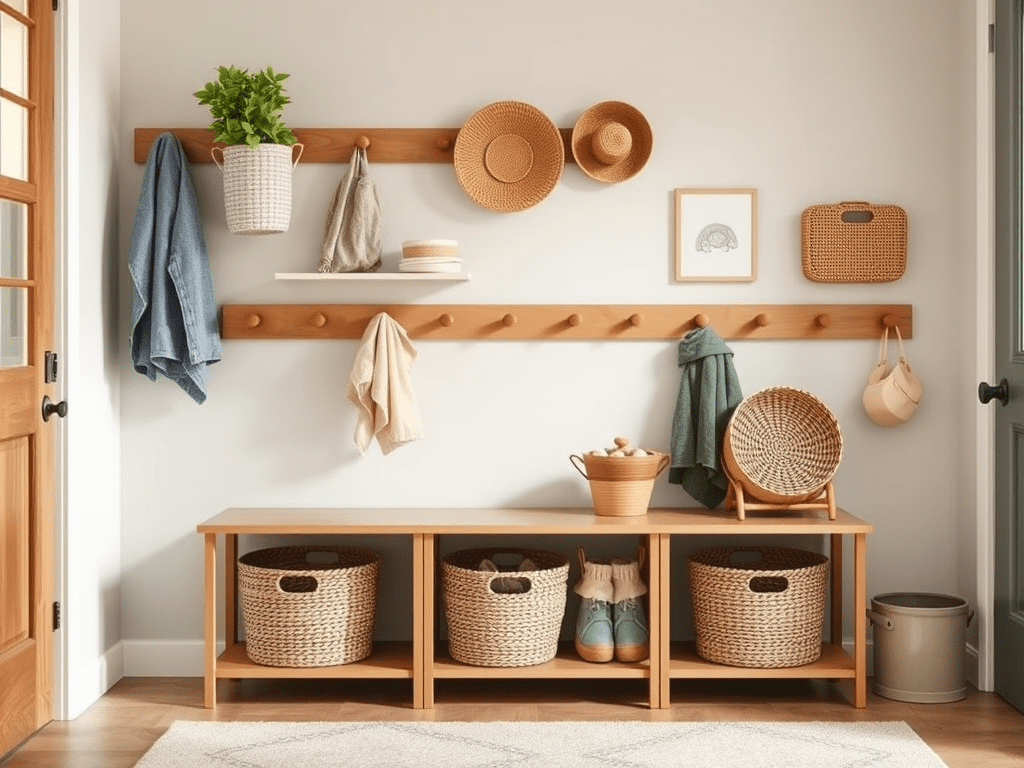
- Key Takeaways: Montessori Entryway Essentials at a Glance
- The Primary Color Plastic Problem Nobody Talks About
- What Makes a Montessori Entryway Actually Work
- Quick Reference: Essential Montessori Entryway Measurements
- Designing Your Minimalist Montessori Command Center
- The Color Palette That Calms Instead of Stimulates
- Practical Systems for Daily Flow
- Shopping Smart: The Montessori Minimalist Investment
- IKEA Kallax Hacks for Montessori Entryways
- Real Talk: What This Looks Like After Two Weeks
- Teaching Kids to Maintain the System
- Troubleshooting Common Problems
- The Long Game: Entryway Organization as Life Skill
- Making It Happen: Your First Steps
Walking into a home should feel like exhaling.
But if you’re a parent, your entryway probably looks more like a bomb went off in a sporting goods store backpacks tangled with yesterday’s jackets, sneakers forming abstract sculptures across the floor, and that mysterious pile of papers that multiplies overnight like some kind of science experiment gone terribly, terribly wrong.
You know this scene intimately because you live it every single day.
Here’s what makes it even more frustrating: you’ve seen those gorgeous minimalist entryways on Pinterest, the ones with their carefully curated hooks and single strategically placed basket, and you think, “That would last exactly four minutes in my house.”
You’re not wrong to be skeptical, but what if I told you there’s a way to merge the calm, intentional aesthetics you crave with the reality of raising actual children who accumulate stuff like it’s their job?
Welcome to the world of aesthetic Montessori entryway ideas for 2026 a design philosophy that’s revolutionizing how families think about their home’s first impression without sacrificing sanity or style.
Key Takeaways: Montessori Entryway Essentials at a Glance
| Feature | Montessori Recommendation | Minimalist Aesthetic Choice |
|---|---|---|
| Hook Height | Child’s shoulder level (24-48″ depending on age) | Natural wood peg rail in oak, walnut, or painted finish |
| Shoe Storage | Open & accessible at floor level | Woven seagrass or water hyacinth baskets |
| Color Scheme | Low-stimulation, neutral tones | Warm neutrals (greige, sage, alabaster, soft gray) |
| Storage Type | Child-reachable closed containers | Natural fiber baskets, wood benches with hidden compartments |
| Materials | Natural, tactile textures | Wood, rattan, linen, cotton, jute |
| Organization Style | Everything visible has a home | Concealed chaos, displayed calm |
The Primary Color Plastic Problem Nobody Talks About
Let’s address the elephant in the room. Or more accurately, the bright red storage bin screaming from your hallway.
Somewhere along the parenting journey, we collectively decided that anything designated “for kids” needed to look like it was designed by a committee of overstimulated toddlers. Primary colors everywhere. Plastic bins with cartoon characters. Labels featuring comic sans font and clipart borders that make your inner designer weep quietly into her coffee.
The problem? This stuff works functionally but destroys your home’s aesthetic faster than you can say “open concept living.” You want your space to feel cohesive, adult, and intentional not like a daycare center exploded in your foyer. As a blogger and design enthusiast, I’ve spent years wrestling with this exact dilemma, and I can tell you with absolute certainty: you don’t have to choose between organization and beauty.
The Montessori approach offers something radically different. It’s rooted in respect respect for the child’s independence, yes, but also respect for your home as a sanctuary that serves everyone who lives there. According to the American Montessori Society, prepared environments should foster independence while maintaining order and beauty principles that translate perfectly to modern home design.
What Makes a Montessori Entryway Actually Work
Traditional Montessori principles emphasize child-sized furniture, accessible storage, and natural materials. Sounds lovely in theory, right? But here’s where most people get stuck: they think Montessori means everything needs to be visible, which feels like the opposite of “hiding kid chaos.”
Not quite.
The genius of a Montessori command center lies in strategic accessibility. Everything your children need is within their reach and sight, but it’s contained, intentional, and visually harmonious with your minimalist aesthetic. Think closed baskets in natural fibers rather than open plastic bins. Wooden pegs instead of brightly colored hooks. Neutral tones that blend rather than shout.
This approach mirrors the family-friendly mindfulness activities we’ve explored before creating systems that reduce mental clutter while promoting independence. When kids know exactly where their things belong and can access them without adult intervention, morning routines transform from battlegrounds into smooth operations.
The Three Pillars of Hidden Organization
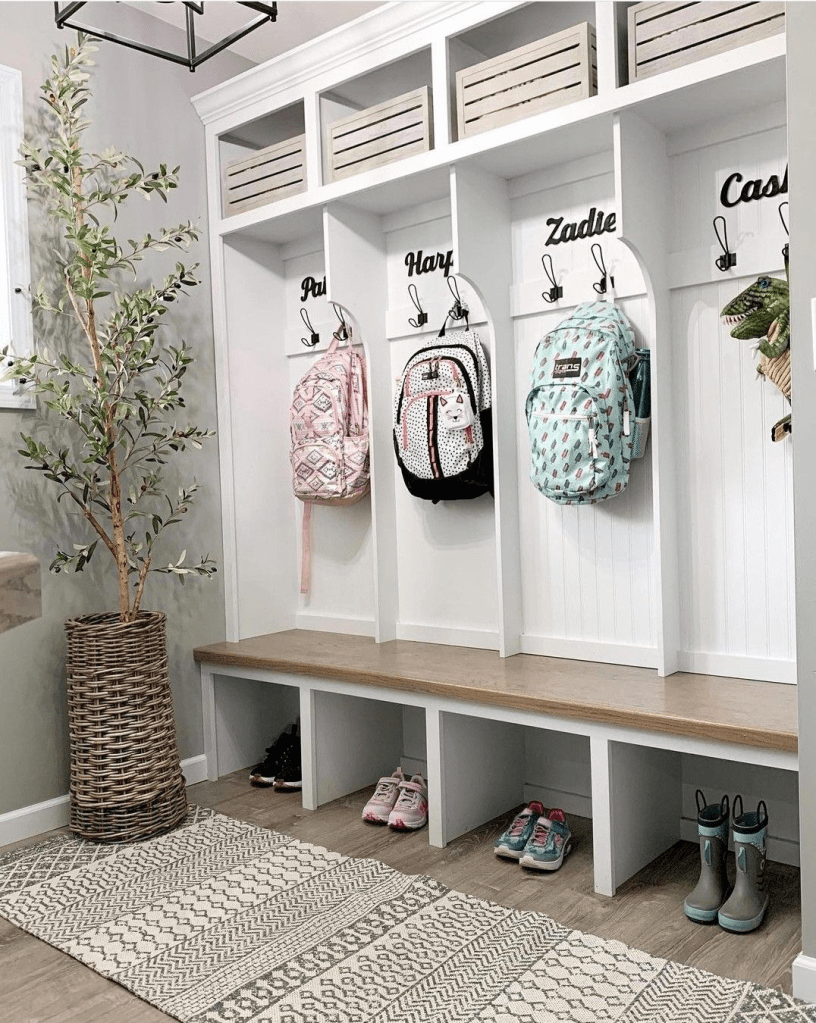
Accessibility without visual noise. Your four-year-old should be able to grab her jacket without your help, but that doesn’t mean the jacket needs to live on a neon hook shaped like a giraffe. Low-mounted wooden pegs or rails work beautifully, keeping coats at kid-height while maintaining clean lines.
Everything has a home. This sounds obvious until you realize how many entryway items exist in organizational limbo. The gymnastics bag. The library books that need returning. The sunscreen you grab on the way out. Each category needs a designated, child-accessible spot that doesn’t scream “CHILD LIVES HERE” in visual terms.
Beauty serves function. This is where aesthetic Montessori entryway ideas for 2026 truly shine choosing pieces that work hard while looking effortless. A handwoven basket holds mittens more beautifully than a plastic bin ever could. A simple wooden bench with hidden storage beats a jumble of shoes every time.
Quick Reference: Essential Montessori Entryway Measurements
What is the best height for Montessori coat hooks?
The ideal hook height depends on your child’s age and shoulder level. For toddlers (2-3 years), mount hooks at 24-30 inches from the floor. For preschoolers (4-5 years), aim for 32-36 inches. Elementary-aged children (6-10 years) need hooks at 40-48 inches.
Install a second row at adult height (60-65 inches) above the children’s hooks for coats you don’t want little hands grabbing. Always measure to your child’s actual shoulder height rather than relying on age-based averages every kid grows differently.
How do you hide shoes in a minimalist entryway?
Forget exposed shoe racks. Use large, shallow baskets in natural materials like seagrass, water hyacinth, or woven rattan one basket per family member.
These slide under benches or nestle beside them, keeping shoes contained and out of sight while adding organic texture to your space. For even more discreet storage, choose a bench with lift-up seating that reveals hidden compartments.
IKEA’s MACKAPÄR bench offers this functionality at an accessible price point, while higher-end options like the West Elm Mid-Century Storage Bench provide the same concept with premium materials.
Why choose natural materials for kid storage?
Natural materials like wood, rattan, seagrass, and cotton offer several advantages over plastic alternatives. They’re visually warm and blend seamlessly with adult décor rather than announcing “kids’ stuff” in bright primary colors. They’re tactilely engaging, which Montessori philosophy values for sensory development.
They’re often more durable than cheap plastic options and age gracefully rather than looking shabby after a year. And importantly, they signal to children that their belongings deserve the same quality and respect as adult items a subtle but powerful message about their place in the family home.
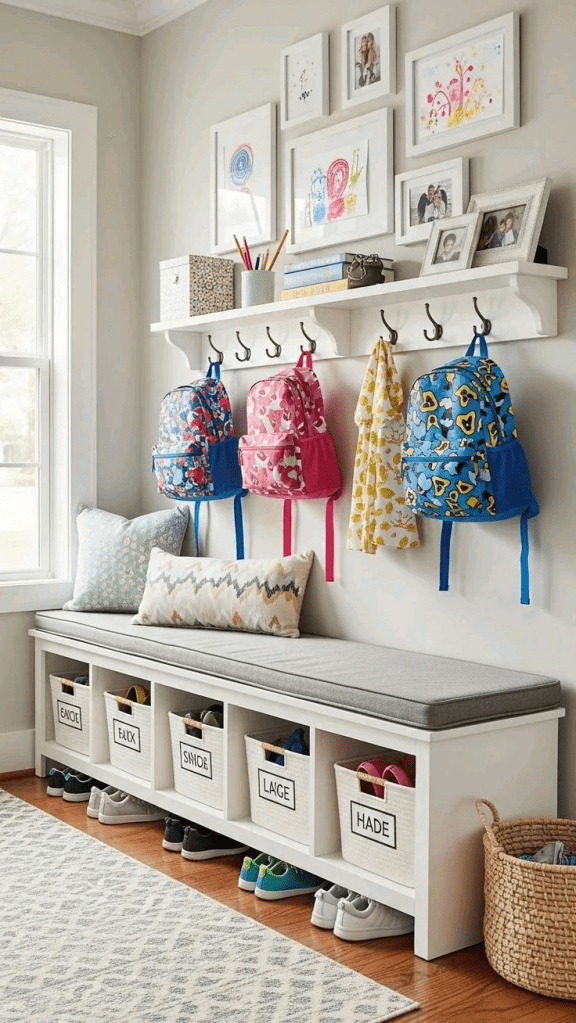
Designing Your Minimalist Montessori Command Center
Start by getting brutally honest about what actually enters and exits through your door daily. Not what you wish it was, but what it actually is.
For most families, this includes: shoes (many shoes), coats and jackets, backpacks, sports equipment, keys, wallets, mail, reusable shopping bags, dog leashes, and that random collection of rocks your kindergartener insists are “special treasures.” Your entryway needs to handle all of it without looking like a storage unit.
The Foundation: Low-Profile Storage That Disappears
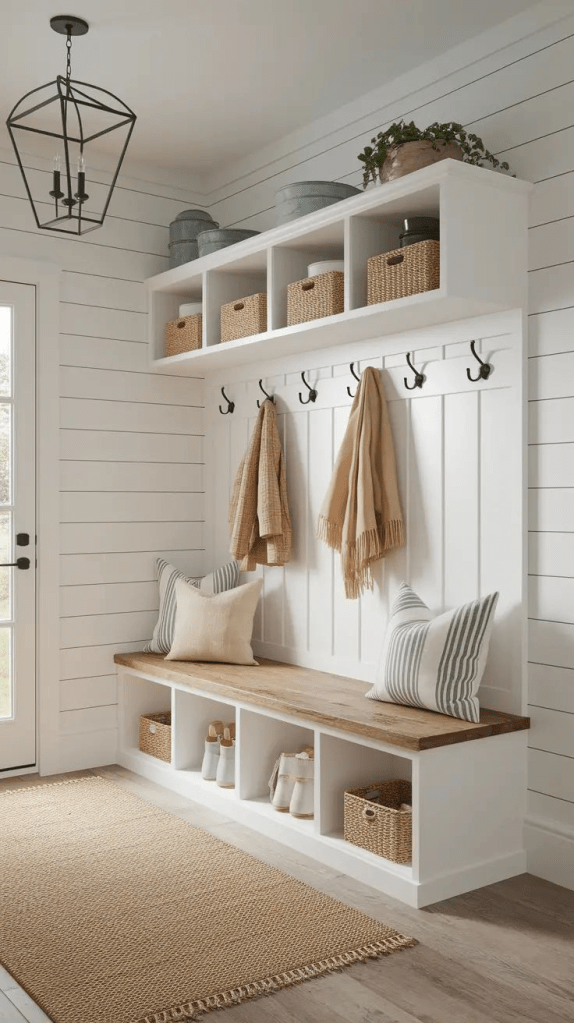
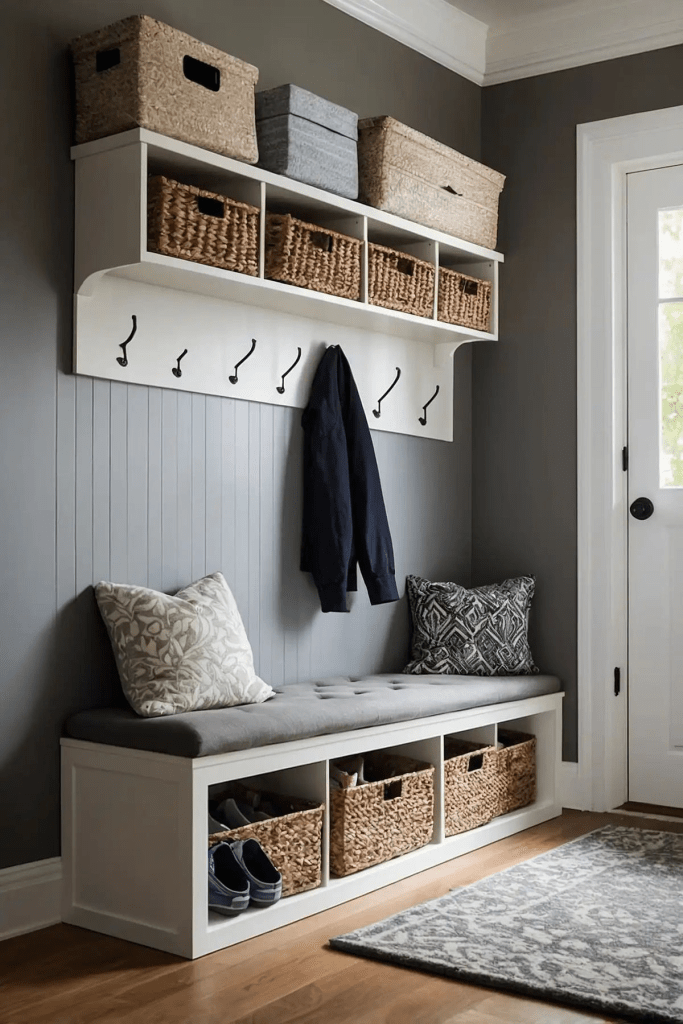
Bench seating with concealed storage forms the backbone of any successful family entryway. Look for designs in light oak, walnut, or painted finishes that match your walls the goal is for the piece to recede rather than dominate. Inside, use fabric bins in neutral linen or cotton to sort by category: one for hats and gloves, one for sunscreen and bug spray, one for outdoor toys that migrate inside.
The bench serves triple duty: shoe-tying station, hidden storage, and landing zone for bags. Choose something around 14-16 inches high so younger children can sit comfortably while maintaining the low profile that keeps sightlines open.
For budget-conscious DIYers, the IKEA KALLAX shelf (positioned horizontally) with the bench cushion insert creates an excellent Montessori-friendly storage solution. Add fabric bins in the cubbies and you’ve got accessible, categorized storage that costs a fraction of custom built-ins.
For a more elevated look, consider Crate & Barrel’s Aspect collection or the Article Meno bench both offer clean lines in natural wood finishes that photograph like a design magazine.
Closed cubbies beat open shelving when you’re hiding chaos. I know, I know open shelving photographs beautifully and looks so intentional in those designer homes. But unless you’re prepared to style your entryway like a photoshoot every single morning, closed storage will serve you better.
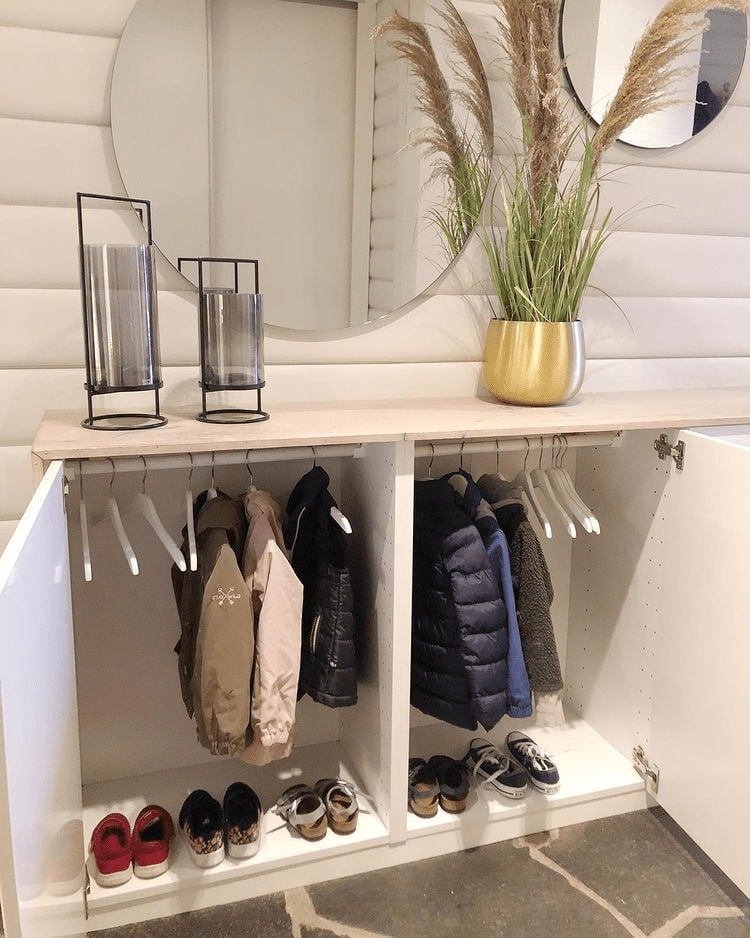
Consider a low credenza or console with doors, positioned at a height where children can reach the lower portion independently. You control what’s visible on top (a simple bowl for keys, maybe a small plant), while the messy reality stays concealed behind clean cabinet fronts.
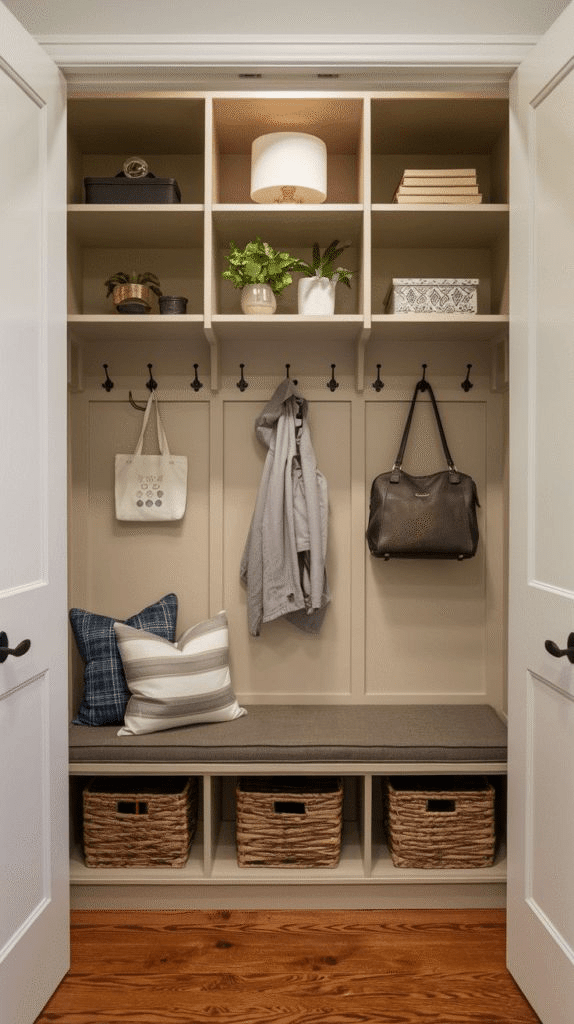
Height-Appropriate Hanging Solutions
This is where Montessori principles really earn their keep. Traditional coat closets require adult intervention doors to open, high rods to reach, hangers to manipulate. Not exactly independence-promoting.
Instead, mount a simple wooden peg rail or a series of individual hooks at your child’s shoulder height, roughly 36-40 inches from the floor for elementary-aged kids, lower for toddlers. Use the same finish as your bench for visual cohesion. Above the child-height hooks, install a second row for adult coats at standard height (about 60-65 inches).
This two-tier system keeps everyone’s belongings accessible while maintaining clear visual zones. Choose hooks in brushed brass, matte black, or oiled bronze finishes that feel grown-up and intentional rather than playroom-adjacent.
Pro tip: Limit each child to 2-3 hooks maximum. More than that and coats start layering into an unusable pile. If you have multiple kids, assign hooks by establishing a clear left-to-right order that matches their heights or ages.
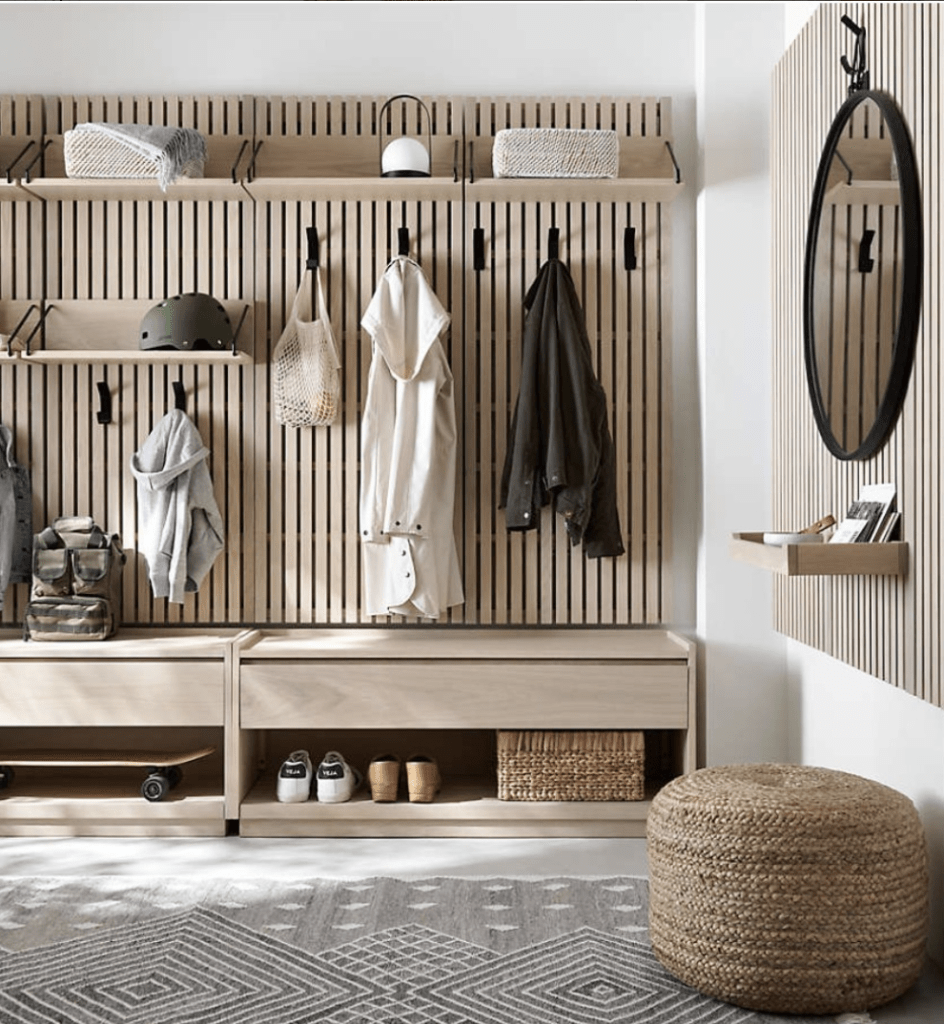
Seagrass vs. Rattan: Which Natural Fiber Works Best?
Both materials deliver that organic, minimalist aesthetic, but they serve slightly different purposes.
Seagrass (woven from aquatic plants) is incredibly durable, naturally water-resistant, and perfect for shoe storage where dampness might be an issue. It’s typically more affordable and has a tighter weave that won’t snag on sharp edges or small fingers. The texture reads as casual and beachy.
Rattan (from palm vines) is lighter in color and weight, offering a slightly more refined appearance. It’s excellent for storing lighter items like scarves, hats, or mail. The looser weave creates beautiful shadow play but can catch on Velcro or sharp objects. For a cohesive look, choose one material and stick with it across all your baskets, or intentionally mix both with seagrass for floor-level storage and rattan for elevated shelves or decorative accents.
Water hyacinth offers a middle ground smooth like seagrass but with rattan’s lighter color palette. It’s my personal favorite for visible storage because it photographs beautifully while being nearly indestructible.
The Basket System That Actually Works
Here’s where natural materials become your secret weapon against the primary color plastic invasion.
Shoes: Use large, shallow baskets one per family memberin seagrass, water hyacinth, or woven rattan. They slide under the bench or sit beside it, keeping shoes contained and off the floor while looking intentionally styled. Kids can toss shoes in without precision, and the texture adds warmth to your entryway rather than visual clutter.
Daily essentials: Small rectangular baskets or fabric bins on a low shelf can hold the grab-and-go items each family member needs. Your daughter’s hair elastics and face mask, your son’s baseball cap, the dog’s leash each category gets its own neutral container with a subtle label (if you must label, use a label maker with a simple font or handwritten tags on kraft paper, nothing in primary colors).
Seasonal rotation: This is the game-changer most people miss. Keep a larger basket or bin in your coat closet or garage for off-season gear. When winter arrives, swap the sunscreen and sidewalk chalk for hats and mittens. Your entryway baskets should only hold what you’re actually using this month, not every possible scenario from beach day to blizzard.
Similar to the way we approached teen bedroom organization by editing belongings seasonally, this rotation keeps your entryway from becoming overwhelmed while teaching kids that not everything needs to be accessible all the time.
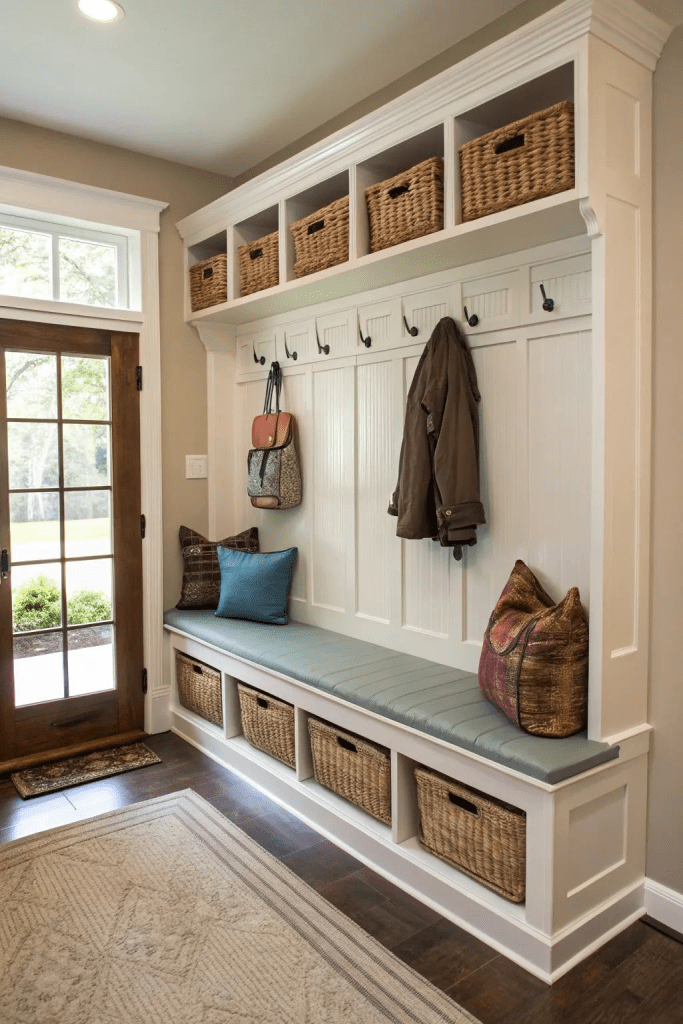
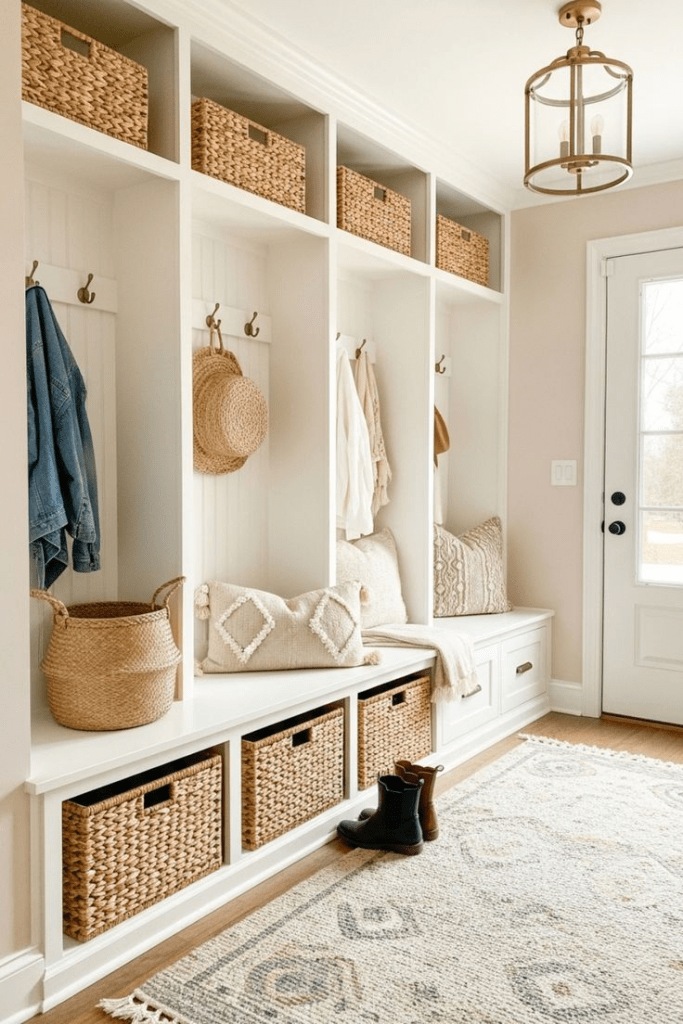
The Color Palette That Calms Instead of Stimulates
This is where aesthetic Montessori entryway ideas for 2026 diverge most dramatically from traditional kid-focused design.
Forget the rainbow. Your entryway palette should feel like a warm exhale neutral, natural, and cohesive with the rest of your home. This doesn’t mean boring or cold; it means intentional.
Base layer: Start with your walls. Warm whites, soft grays, gentle greiges, or even deeper tones like sage or dusty blue create a sophisticated backdrop that won’t compete with the activity happening in the space. If you’re renting or don’t want to paint, this still works just choose your furnishings and accessories to establish the tone.
For those ready to commit to paint, consider Farrow & Ball’s “Elephant’s Breath” (a warm greige with depth), Benjamin Moore’s “Revere Pewter” (the most forgiving neutral that works with both warm and cool tones), or Sherwin Williams’ “Alabaster” (a soft white with subtle warmth). According to Architectural Digest’s 2026 design trend report, these nuanced neutrals continue to dominate sophisticated interiors precisely because they create calm without feeling sterile.
Natural materials: Wood in light to medium tones brings warmth without overwhelming. Oak, ash, maple, and bamboo all photograph beautifully while standing up to daily abuse from backpacks and hockey sticks. Avoid overly distressed or farmhouse-style pieces unless that’s your whole-home aesthetic sleek and simple usually integrates more successfully with minimalist design.
Textile texture: This is where you add visual interest without color chaos. A jute or sisal rug defines the entryway zone while hiding dirt between vacuums. Linen curtains (if you have a window) soften hard surfaces. Woven baskets in varying textures create subtle pattern through their weave rather than through graphic prints.
Accent choices: If you want to introduce color, do it through elements you control rather than kid gear. A single terracotta pot with a hardy plant, a piece of simple artwork, or even a painted bench in a muted sage or dusty rose. These intentional touches show you made a design choice rather than surrendering to chaos.
The beauty of this neutral palette? When your seven-year-old insists on the sparkly pink backpack (and they will), it reads as a pop of personality against your calm backdrop rather than another screaming element in an already overstimulated space.
Practical Systems for Daily Flow
Design means nothing if it doesn’t support how your family actually lives. Here’s where function meets form in the real world.
The Morning Launch Pad
Create a designated zone for “tomorrow’s outfit” to live overnight. This could be a low-mounted towel bar where kids hang their chosen clothes the night before, or a small basket on the bench labeled “ready for school.” Either way, you’re building independence (they dress themselves from a pre-selected outfit) while preventing the morning “I have nothing to wear” meltdown.
The Paper Management Station
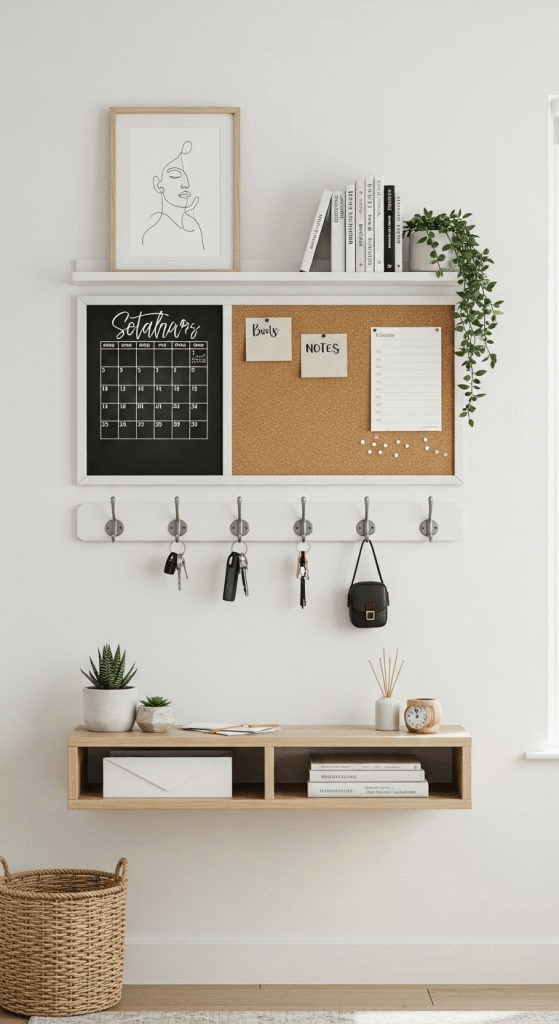
Mail, permission slips, school newsletters, and birthday party invitations will flow through your entryway whether you plan for them or not. Instead of letting them colonize your bench, install a simple mail sorter or magazine rack on the wall something slim and wall-mounted in metal or wood that holds papers vertically.
Better yet, pair this with a small wall-mounted key holder that includes a mail slot. Deal with papers once: trash, recycle, or move to your office/kitchen command center. The entryway is for sorting, not storing.
The “Outgoing Items” Basket
This single addition might save your sanity. Designate one basket near the door for items that need to leave the house: library books to return, hand-me-downs for your sister, the thermos that belongs to your neighbor, supplies for the classroom party. Everything goes in this basket, and you grab it on your way out.
Use a larger, more substantial basket for this purposenot something that blends into the background but something attractive enough that you notice it as you’re leaving. Seagrass or woven water hyacinth in a natural tone works beautifully and holds its shape even when stuffed full.
Shopping Smart: The Montessori Minimalist Investment
You don’t need to spend a fortune to create an aesthetic Montessori entryway, but you do need to shop strategically.
Invest in: The bench. This is your workhorse, and a well-made piece will serve your family for years, potentially decades. Look for solid wood construction, dovetail joints, and finishes that can be touched up if scratched. Companies like Crate & Barrel, West Elm, and even IKEA’s higher-end lines offer options that balance quality with accessibility.
Save on: Baskets. Natural fiber baskets are everywhere right now, from HomeGoods to Target to Amazon. You don’t need artisanal hand-woven masterpieces for shoe storage you need baskets that hold their shape and fit your space. Mix high and low, saving your budget for the visible pieces.
DIY when possible: Peg rails are remarkably simple to install yourself with a drill, level, and basic woodworking skills. Purchase individual Shaker pegs or simple dowel rods from a hardware store, paint or stain them to match your aesthetic, and mount them at the appropriate heights. You’ll spend a fraction of what custom built-ins would cost.
Avoid: Anything labeled “kids’ organization system.” The markup is absurd and the aesthetic is usually terrible. Shop the regular home organization section and choose pieces in materials and finishes you’d use elsewhere in your home.
IKEA Kallax Hacks for Montessori Entryways
The IKEA KALLAX unit deserves its cult following among design-conscious parents because it’s essentially a blank canvas for customization. Here’s how to transform this affordable staple into a sophisticated Montessori command center:
Horizontal orientation: Flip the KALLAX on its side rather than standing it vertically. This brings storage down to child height while creating a bench-like surface when paired with a cushion.
Natural fabric inserts: Ditch the brightly colored bins IKEA tries to sell you. Instead, use natural canvas, linen, or cotton storage cubes in cream, oatmeal, or soft gray. These transform the entire aesthetic from “student apartment” to “intentional family home.”
Custom wood top: Have a piece of plywood cut to size at your local hardware store, stain it in a warm oak or walnut tone, and attach it to the top of your KALLAX. This creates a polished bench surface that hides the particleboard edges and allows you to add cushions for comfortable seating.
Painted finish upgrade: If you’re feeling ambitious, paint the entire KALLAX unit in a sophisticated matte finish soft sage, warm greige, or even a deep charcoal. Use a primer designed for laminate furniture and finish with a protective topcoat. The transformation is remarkable.
Mixed storage approach: Use fabric bins in some cubbies for hidden storage while leaving others open to display beautiful baskets or a single decorative object. This prevents the unit from feeling too busy while maintaining functionality.
Real Talk: What This Looks Like After Two Weeks
Let’s be honest about maintenance because no organizing system works if it’s not sustainable.
The first few days will feel magical. Everything in its place, kids enthusiastically using their hooks, shoes actually in baskets. You’ll take photos for Pinterest and feel like you’ve finally figured out this parenting thing.
Then reality hits.
Someone will throw their jacket on the floor despite the hook being literally right there. Shoes will migrate. Papers will pile up. This is normal. This is life.
The difference is that with a proper Montessori command center, you have a system to return to. The evening reset takes five minutes instead of twenty because everything has a designated home. You’re not reorganizing from scratch; you’re just putting things back where they belong.
The key to maintaining your minimalist aesthetic: Daily resets. Before bed, take literally three minutes to restore order. Hang the jackets, toss shoes in baskets, deal with papers, and clear the bench surface. Your morning self will thank you, and your entryway will maintain its calm, intentional vibe rather than descending into chaos.
Teaching Kids to Maintain the System
Here’s where Montessori philosophy really shines children are fully capable of maintaining organized spaces when we give them the tools and expectations to do so.
Make it visual: For younger kids, consider taking photos of what the entryway looks like “ready” and posting this photo somewhere visible. They can reference the image to check their work rather than relying on your verbal instructions.
Build it into routines: The entryway reset happens at specific times: after school, before dinner, or before bed. Consistency creates habits, and habits become automatic over time.
Natural consequences: If your child can’t find their soccer cleats because they didn’t put them in their basket, they experience the natural consequence of that choice. You’re not rescuing them by tearing apart the house you’re allowing them to learn from the experience. This is respectful to both you and the child.
Celebrate systems, not perfection: When your seven-year-old remembers to hang their backpack without being asked, acknowledge it. “I noticed you put your backpack on your hook that’s really helpful and makes our morning easier.” You’re reinforcing the behavior and connecting it to the family benefit, not demanding perfection.
Troubleshooting Common Problems
“My entryway is literally a 3-foot hallway. This won’t work.”
It absolutely will, just scaled down. Even tiny spaces can handle a wall-mounted peg rail and a single basket for shoes. Consider a narrow console table (8-10 inches deep) rather than a bench, or wall-mounted drop-down seats that fold when not in use. The principles remain the same; you’re just working with less square footage.
“We don’t have a designated entryway people walk straight into our living room.”
Create one with furniture placement and visual definition. A narrow rug perpendicular to the door establishes the “landing zone.” A console table against the wall with hooks above it functions as your command center even without architectural boundaries. You’re building a designated drop zone through design rather than relying on walls.
“My kids are teenagers they think Montessori is for babies.”
The aesthetic Montessori approach works brilliantly for teens because it looks sophisticated, not childish. Frame it as a mature system that gives them independence and privacy their own designated space for their stuff without parental nagging. Teens actually crave order more than we give them credit for; they just don’t want it to look like we’re treating them like children.
“What about guests? Won’t they think it’s weird that everything is so kid-accessible?”
Most guests will either not notice (because it blends so beautifully) or be impressed by the thoughtful design. If anything, the aesthetic Montessori approach reads as more sophisticated than a traditional entryway precisely because it’s intentional rather than default. You’re making design choices, not accepting whatever the furniture store marketed to parents.
The Long Game: Entryway Organization as Life Skill
Here’s what I’ve learned after years of refining these systems both in my own home and as a design enthusiast: teaching children to maintain organized, beautiful spaces isn’t just about a tidy entryway.
You’re modeling that organization and aesthetics aren’t mutually exclusive. You’re teaching spatial awareness, respect for shared spaces, and the connection between environment and mental state. These aren’t small things.
When your daughter grows up and moves into her first apartment, she won’t default to plastic bins and chaos because that’s what she learned at home. She’ll understand that functional spaces can also be beautiful, that systems serve wellbeing, and that a well-designed environment isn’t an indulgence it’s a foundation for how you want to live.
That’s the real gift of aesthetic Montessori entryway ideas for 2026. Not just a prettier front hall, but a different relationship with your home altogether.
Making It Happen: Your First Steps
Feeling overwhelmed by the possibilities? Start here.
This weekend: Clear everything out of your entryway. Everything. You can’t design around what you have; you need to see the blank canvas first.
This week: Measure your space carefully. Note the heights where children can comfortably reach (measure from the floor to their shoulder). Take photos of entryways you love and identify what specifically appeals to you the color palette? The storage solutions? The minimal vibe?
This month: Invest in one anchor piece probably the bench or console table. This sets the tone for everything else. Once you have your foundation, build around it with baskets, hooks, and organizing elements that complement rather than compete.
This year: Refine and adjust. Your needs will change as kids grow, seasons shift, and life evolves. The beauty of this system is its flexibility. You’re not locked into a rigid solution; you’re creating a framework that adapts.
The entryway you walk past twenty times a day doesn’t have to be a source of stress or aesthetic compromise. It can be both functional and beautiful, both child-friendly and design-forward, both organized and genuinely livable.
It just requires thinking differently about what “kid stuff” has to look like and believing that you deserve a home that serves everyoneincluding you. The Montessori command center isn’t about perfection or Pinterest-worthy moments. It’s about creating systems that actually work while respecting your aesthetic sensibilities and your sanity.
Your minimalist entryway that successfully hides kid chaos? It’s not a fantasy. It’s a carefully designed system that starts with understanding your family’s needs and ends with a space that makes you smile instead of sigh every time you walk through the door.
And honestly? That’s worth every bit of the effort.
Follow, Share and Suscribe!
 Linda Designs | Home Decor, Interior Design & Lifestyle Inspiration